
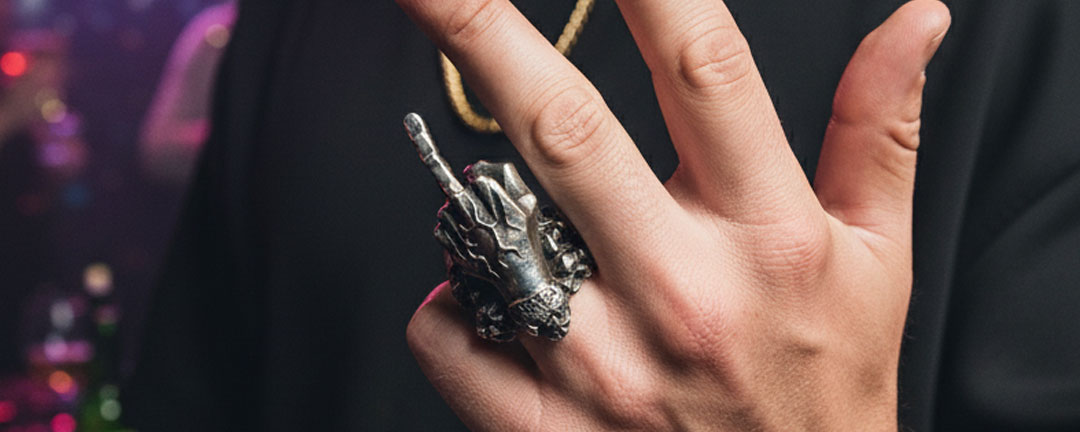
What men’s ring styles are showing up in current 2026 coverage? The clearest dated editorial signals are signet shapes, sculptural statement rings, visible texture, and deliberate ring arrangements. Treat those signals as ways to compare silhouettes, not as proof that one ring is universally fashionable, popular, higher quality, comfortable, or right for every wearer.
A useful trend guide should help you see the difference between a compact signet outline, a raised sculptural face, and a textured surface from normal viewing distance. It should also separate editorial observation from product truth. Current articles can report what editors are featuring. MENSSKULL product pages can show current catalog shapes and listed dimensions. Neither source alone proves demand, fit, durability, material performance, or personal style.
Quick answer: three visible ring directions
For a practical 2026 comparison, start with three visual directions. First, signet-based rings use a defined top plane or framed face. Second, sculptural rings build a recognizable object, head, helmet, wing, or character above the band. Third, textured rings use relief, recesses, oxidation contrast, engraving, or irregular surfaces to create detail without relying only on size.
These directions can overlap. A skull ring may use a signet-like frame, sculptural facial depth, and dark recesses at the same time. The point is not to force every design into one box. The point is to identify which feature leads when the ring is seen with an outfit. For a broader category view beyond rings, use the fall 2026 silver jewelry trend guide for men.
What the dated sources actually support
Current editorial coverage is useful when its date and scope are kept visible. A British GQ men’s-ring guide dated September 23, 2026 includes signet and statement-ring selections. A Robbins Brothers fall men’s-jewelry report dated September 29, 2026 discusses signets, pinky rings, and ring stacks in its current-season coverage.
Those sources support a narrow conclusion: these forms were present in recent editorial and retailer coverage. They do not establish MENSSKULL sales, market share, sales ranking, universal popularity, or the performance of any individual product. A dated signal can help a buyer notice a form, but the buyer still needs to decide whether that form works with his wardrobe and preferred level of visual emphasis.
Compare the signals before choosing a ring
| Visual signal | What you can observe | Decision question |
|---|---|---|
| Signet structure | A defined top face, framed emblem, crest-like panel, or broad plane | Do you want the top surface to read as the main graphic element? |
| Sculptural statement form | Raised depth, recognizable three-dimensional subject, strong side profile | Should the ring remain identifiable from more than one viewing angle? |
| Textured profile | Relief, recesses, engraved lines, dark-light contrast, irregular surface rhythm | Do you want detail to appear gradually rather than through one flat emblem? |
| Compact arrangement | One ring carries the focal point while the rest of the hand stays visually quiet | Is a single clear accent easier to coordinate with your watch and sleeves? |
| Multiple-ring arrangement | Several separate outlines create a wider composition across one or both hands | Can each silhouette remain readable instead of merging into one dense cluster? |
The observations in this table concern appearance only. They do not prescribe ring size, finger clearance, comfort, activity use, or the number of rings a person should wear. For the narrower arrangement decision, use the dedicated men’s ring-count and balance guide.
Signet forms: a clear top plane
A signet is easy to recognize because the top of the ring becomes a deliberate display area. That area may be flat, domed, framed, engraved, or built around an emblem. From a normal conversational distance, the eye first reads the outline of the top plane and then notices the smaller details inside it.
This structure makes signet forms useful when you want a ring to behave like a compact badge. A rectangular, oval, shield, or crest-like face can look organized even when the surface contains a complex motif. The form also works with understated outfits because the ring supplies one concentrated shape rather than a field of small competing details.
Signet does not automatically mean minimal. A skull, animal, cross, or heraldic motif can sit inside a signet-like frame. Conversely, a plain top can feel visually strong if it is broad enough to contrast with the hand. Compare the visible face, edge treatment, and side transition rather than assuming that every signet has the same degree of formality or prominence.
Sculptural rings: depth that reads from several angles
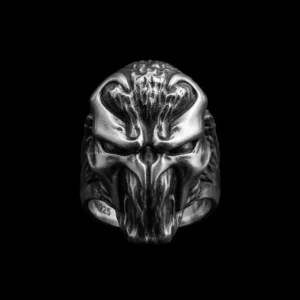
Sculptural rings use depth as part of the design. A raised forehead, wing, helmet, jaw, horn, or moustache can change the outline when the hand turns. The front view may show a recognizable subject, while the side view reveals how far the design rises and where its mass sits over the band.
This type of ring often becomes the clearest focal point on the hand because it creates both shape and shadow. That does not make it better than a lower-profile ring. It simply means the ring may require more visual space around it. A single sculptural ring can be easier to read than several equally detailed pieces placed side by side.
Use full-outfit photos rather than only product close-ups. Close photography magnifies detail that may be subtler at normal distance. A sculptural ring that looks extremely complex in a macro image may read as one bold silhouette when worn with a jacket or dark shirt. The skull ring styles guide owns the broader motif taxonomy; this page stays focused on current visual directions.
Read the profile at three viewing distances
A ring can communicate different information at close, conversational, and full-outfit distances. Close viewing reveals engraved lines, recessed areas, facial features, and transitions between polished and dark sections. Conversational distance reduces those details into larger blocks of light and shadow. Full-outfit distance usually leaves the overall top shape, amount of contrast, and relationship to other accessories.
Use all three distances because a trend label often describes the close view while an outfit decision depends on the wider view. A highly textured surface may look intricate in a product image yet read as a simple dark-light pattern from across a room. A signet may appear restrained in a close crop but become visually dominant when its broad top is compared with an otherwise plain sleeve. A sculptural head may lose small facial details while retaining a strong rounded or vertical outline.
Start with the full-outfit view to decide whether the ring has the right level of prominence. Move closer to check whether the leading motif remains clear. Finish with the close view to compare workmanship details that are actually visible in the supplied images. This order prevents a magnified photograph from deciding the whole outfit before proportion has been considered.
Lighting also changes what each distance reveals. Strong directional light emphasizes raised edges and deep recesses. Soft light reduces contrast and makes the outer silhouette more important. Compare rings under similar conditions so the decision reflects form rather than a difference in photography. The result remains an appearance comparison, not evidence of surface performance, maintenance needs, or how the ring will change over time.
Textured profiles: detail through surface rhythm
Texture changes how light moves across a ring. Raised and recessed areas create alternating highlights and shadows. Engraved lines can direct the eye around a face or along a band. Darkened recesses can separate adjacent forms and make the relief easier to see without adding another color.
Texture can lead the design or support it. On a compact signet, texture may create depth inside the top plane. On a sculptural ring, it may distinguish hair, bone, feathers, fabric, armor, or mechanical details. On a simpler band, hammered or irregular surfaces may be the main visible feature.
Describe texture as an observable design choice. Do not use appearance to infer manufacturing quality, scratch resistance, aging behavior, or care requirements. Those are separate factual questions. For documented alloy and hallmark context, use the 925 sterling silver Research guide.
Use visual proportion, not trend labels alone
The word “statement” is too vague unless it is tied to visible proportion. Look at the width and height of the top, how much of the finger remains visible, and whether the design extends horizontally, vertically, or upward. Then compare that outline with the cuff, watch, bracelet, belt hardware, and other jewelry in the same outfit.
A horizontally spread motif can echo the line of a cuff or watch case. A tall character face can create a vertical accent. A compact top can leave more negative space around neighboring fingers. None of those observations proves fit or comfort, but they help explain why two rings with similar themes may create very different visual effects.
If you need measurement and fit guidance, leave that decision to the men’s ring size and fit Research owner. A ring can look proportionally balanced in a photograph while still requiring its own verified sizing decision.
Three current MENSSKULL profile examples
Current catalog pages can illustrate how signet structure, sculptural depth, and texture combine. The examples below are commercial references, not evidence that a style is popular or that a product performs better. Listed millimeter values are item-specific catalog facts; NIST’s SI length guidance supplies standards context for the unit only.
| Current catalog example | Listed visible dimensions | Observable profile |
|---|---|---|
| Winged Male Skull Ring | 29 by 21 mm top | A skull face with a horizontally extended winged outline and raised relief |
| Handlebar Mustache Skull Ring | 33 by 20 mm top | A tall character-skull face with moustache detail and pronounced sculptural depth |
| Helmeted Biker Skull Ring | 32 by 23 mm top | A helmeted skull profile combining a defined head shape with recessed detail |
These examples are useful because their leading forms differ. The winged ring spreads the motif laterally. The moustache skull emphasizes a tall character face. The helmeted ring builds a rounded head and equipment profile. Product pages do not prove a trend, popularity, material quality, fit, comfort, durability, care performance, or suitability for a particular activity.
How to coordinate one statement ring
Begin with the ring as the only hand focal point. Put on the full outfit, stand at normal viewing distance, and check whether the motif is still recognizable. If the ring disappears, contrast may be too low or the surrounding accessories may be too visually busy. If the hand becomes much heavier than the rest of the outfit, remove one nearby accent before changing the ring itself.
Next, compare the ring with the nearest wrist detail. A watch with a large case or a wide cuff adds another strong shape. Keeping both on one side creates a concentrated accessory zone. Separating them across the hands distributes the metal details. The choice is compositional, not a universal rule.
Dark shirts, denim, leather, and structured outerwear can give bright edges and dark recesses a clear background. Lighter garments may produce a quieter contrast. Observe the result under the lighting where the outfit will actually be seen; a highly directional product photograph is not a substitute for the full look.
How to compare a ring arrangement
When more than one ring is involved, place the strongest silhouette first. Add the second ring only after you can see what visual job it performs. It might echo the leading ring’s geometry, provide a simpler counterpoint, or distribute attention to the other hand. If it has no clear role, the arrangement may be easier to read without it.
Spacing matters visually. Two broad sculptural tops placed next to each other may merge into one dense block from a distance. Moving one ring to another finger or hand can restore separation. A compact band beside a sculptural ring may support the focal piece without competing with its outline.
This is not advice about finger clearance, joint movement, workplace use, exercise, or safe wear. Those questions need appropriate fit or safety evidence. Here, the test is simply whether each ring remains legible and whether the total arrangement matches the intended level of prominence.
A buyer’s photo test for current styles
Use four photographs to compare a ring before relying on a trend label. First, take a straight-on hand photo. Second, turn the hand enough to reveal the side profile. Third, take a waist-up outfit photo. Fourth, take a full-length photo with the watch, bracelet, chain, and belt hardware visible.
The straight-on view shows the top plane. The side view shows sculptural depth. The outfit view reveals whether the ring works as a focal point or becomes lost among other details. The full-length view shows whether the total amount of metal and ornament feels concentrated or distributed.
Keep the clothing, lighting, and camera distance consistent between options. A fair comparison is more useful than a dramatic close-up. If two rings both work, choose based on the design you prefer rather than trying to convert an editorial signal into a mandatory rule.
Common trend-reading mistakes
- Calling an editorial feature a market fact: recent coverage shows what an editor or retailer chose to discuss, not universal demand.
- Using a product as proof of a trend: a current listing proves that the item is offered, not that its form is the most popular.
- Equating size with quality: a larger visible profile is a design choice, not evidence of construction or value.
- Turning texture into a durability claim: relief and dark recesses describe appearance, not resistance to wear.
- Assuming one arrangement fits every outfit: sleeves, watches, bracelets, and other rings change the visual balance.
- Letting a trend replace preference: dated signals can narrow choices, but they cannot decide what a buyer wants to wear.
A practical 2026 ring-selection sequence
- Choose the leading visual direction: signet structure, sculptural form, visible texture, or a combination.
- Compare the top view and side view instead of judging only the motif name.
- Decide whether the ring should be the only hand focal point or part of a wider arrangement.
- Check the ring with the actual watch, bracelet, sleeves, and other metal details you plan to wear.
- Use item pages for current catalog facts and Research owners for material and fit questions.
- Make the final choice from observed proportion and personal preference, not unsupported popularity claims.
The men’s silver ring collection provides the current commercial path for comparing available silhouettes. Category pages are navigation, not evidence that any design is a trend leader or the right choice for every buyer.
Final answer
The most useful current 2026 men’s-ring signals are signet structures, sculptural statement forms, visible texture, and deliberate single- or multiple-ring arrangements. Recent dated coverage supports discussing those directions, but not claims of universal popularity, MENSSKULL sales, product performance, comfort, fit, or quality.
Use the signals as a visual filter. Identify the leading shape, compare its top and side profiles, and test it with the rest of the outfit. A current ring style is valuable when it helps a buyer make a clearer comparison. It is not a rule, and it does not prove that one product, motif, or arrangement is universally fashionable, safer, more comfortable, more durable, or more meaningful.






MENSSKULL Journal Notes
Leave a field note
Share fit notes, styling ideas, care questions, or your experience with MENSSKULL silver jewelry.
Comments are checked before publication so buyers can read useful fit, symbolism, care, and style notes without spam noise.
The simple plus/minus challenge below helps block automated spam while keeping the experience lightweight.
Continue exploring
More MENSSKULL stories
Handcrafted silver
Shop the pieces behind the stories