
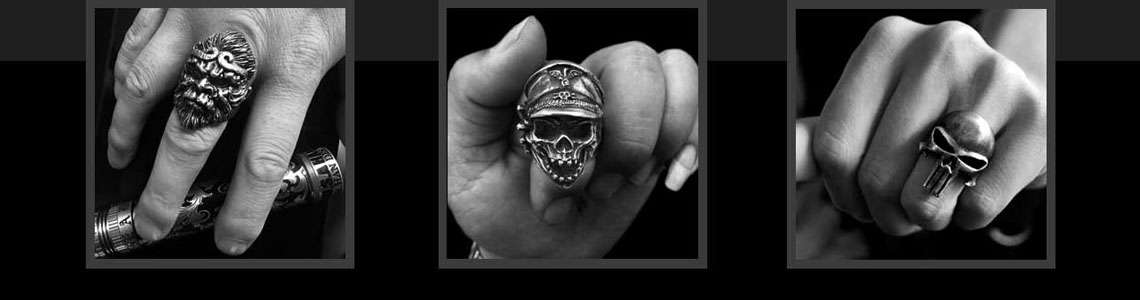
Quick answer: for a party, concert, dinner, or social event, use one skull ring as the hand’s focal point and choose its visual prominence in relation to the outfit. A compact upper-cranium outline reads as a quieter accent, a framed signet face reads as a clear graphic block, and a full-jaw outline creates the strongest motif. Keep the rest of the accessories visually secondary so the ring has one obvious role.
This guide is limited to observable styling: ring outline, surface contrast, event formality, outfit-detail density, and accessory hierarchy. It does not determine fit, venue acceptance, safe wear, hearing protection, material performance, care, durability, status, confidence, or social response. Those are separate decisions and, where applicable, belong with the linked owner pages.
Begin with the event’s visual register
Describe the event by what the clothing is likely to look like rather than by assumptions about the people attending it. A tailored dinner outfit usually presents larger uninterrupted areas of fabric. A live-music look may include graphic layers, boots, hardware, or stronger contrast. A casual gathering may sit between those two. This visual register gives the ring a backdrop.
The decision is not whether one kind of ring is universally right for a concert or a party. It is whether the ring remains readable against the clothing and accessories you have chosen. The same skull outline can look restrained against a detailed outfit and more prominent against a plain one.
Give one skull ring the lead role
A single focal ring creates a clear hierarchy: ring first, supporting accessories second, clothing details third. That hierarchy is useful when the skull motif is already visually specific. Adding several equally detailed pieces can turn the hand into multiple competing focal points.
Start with the skull ring alone. View the whole outfit from normal conversation distance, then add a watch, bracelet, or simpler ring only if the main skull outline remains easy to identify. For broader multi-piece coordination, move to the party-jewelry owner; this page stays with one focal skull ring.
Choose a prominence level, not a personality label
Prominence is observable. It comes from the size of the visible face, the strength of its outline, the contrast between raised and recessed areas, and the amount of empty visual space around the ring. It does not prove confidence, rebellion, masculinity, attraction, status, or any other personal quality.
| Visible ring profile | Best comparison to make | What the profile does not establish |
|---|---|---|
| Compact upper-cranium outline | Whether it reads as a small accent beside a plain cuff or narrow watch | Fit, comfort, event suitability, or preference |
| Framed signet face | Whether the rectangular or coffin-like border creates a distinct graphic block | Status, formality, approval, or material quality |
| Classic full-jaw outline | Whether the longer motif remains clear against the sleeve and other accessories | Safety, performance, popularity, or social effect |
| Any profile with strong surface contrast | Whether raised and recessed areas remain readable in the full outfit | Durability, craftsmanship, symbolism, or value |
Match ring prominence to outfit-detail density
Detail density means how many visible elements compete in the same view. Prints, embroidery, jacket hardware, layered necklaces, watches, bracelets, and textured fabrics all add information. When the outfit is already dense, a compact skull outline can work as punctuation rather than another headline.
With a plain shirt, simple jacket, or largely monochrome outfit, a framed signet or full-jaw form has more open space around it. That extra space can make the ring easier to read without adding more jewelry. The choice is compositional, not a claim that plain outfits require bold rings or detailed outfits require small ones.
Compare three observable skull-ring forms
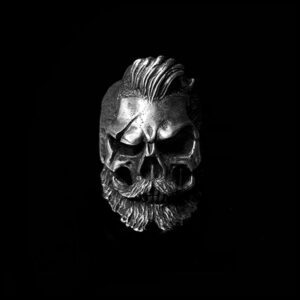
Current catalog examples can make the profile differences concrete. The No Jaw Skull Ring shows a compact upper-cranium silhouette. The Coffin Seal Skull Ring shows a skull face framed by a signet-like border. The Classic Skull Ring shows a longer full-jaw outline.
Use these listings only as visual references for outline and prominence. Their names, photographs, availability, or category placement do not establish event suitability, fit, comfort, material performance, durability, popularity, or a guaranteed styling result.
| Outfit view | Visual question | Possible focal approach |
|---|---|---|
| Plain shirt or jacket with few visible accessories | How much of the hand should become the focal area? | Compare compact, framed, and full-jaw outlines at the same viewing distance |
| Graphic or hardware-rich outfit | Does the ring add a distinct point or merge into existing detail? | Start with the compact outline, then increase prominence only if the motif remains separate |
| Tailored or restrained evening look | Should the ring act as one graphic interruption or a quiet accent? | Compare a framed signet block with the compact upper-cranium form |
| Layered casual outfit | Which visible element should lead: ring, watch, bracelet, or clothing detail? | Select one lead element and reduce the visual weight of the others |
Use contrast without assuming a fixed mood
A ring can become more noticeable when its bright and dark areas contrast strongly, when its outline differs from nearby accessories, or when it appears against a plain sleeve. A lower-contrast surface can blend more closely with other metal details. These are visual observations, not universal mood assignments.
Do not assume that a darker recess automatically makes an outfit aggressive, formal, vintage, rebellious, or mysterious. Describe what can be seen instead: high contrast, low contrast, broad outline, narrow outline, repeated texture, or open space.
Set an accessory hierarchy around the ring
If the skull ring is the lead piece, a watch can serve as a secondary block and a bracelet as a smaller supporting line. If the watch is already visually dominant, the ring can take a quieter role. The goal is not exact matching; it is deciding which item is seen first, second, and third.
Compare both hands together. A ring on the opposite hand from the watch creates two separated anchors. A ring on the watch hand concentrates the metal details on one side. Keep this comparison visual only. It does not answer spacing, contact, fit, or other physical-use questions.
Coordinate with clothing through repetition or contrast
Repetition uses a shared visible feature, such as a geometric border echoed by a belt buckle or a dark recess echoed by dark hardware. Contrast gives the ring a deliberately different outline from the clothing details. Either method can produce a coherent outfit when the hierarchy remains clear.
For general guidance on integrating skull jewelry with everyday outfits, use the outfit-integration owner. It remains a separate, protected page. This event guide does not rewrite its broader decision.
Keep profile taxonomy with its established owner
Terms such as compact, signet, full-jaw, sculptural, and low-relief are useful only when they describe visible form. The skull-ring styles guide owns the broader taxonomy. Use that guide when the main question is how skull-ring forms differ across the category.
For an even wider comparison of men’s ring profiles beyond skull motifs, the general men’s ring profile owner provides the appropriate next step. Both pages are link-only here; their protected content is not restated.
Run a controlled full-outfit comparison
Choose one outfit and keep the clothing, lighting, camera distance, and other accessories unchanged. Photograph the compact, framed, and full-jaw profiles one at a time. Then compare three views: the full outfit, both hands together, and the ring hand beside the nearest accessory.
Write one observable sentence for each option. For example: “The compact outline reads as a small accent beside the cuff.” Another might be: “The framed signet creates the clearest graphic block in the full-outfit view.” This avoids turning a visual preference into a claim about personality or social response.
Separate event styling from fit and product facts
A visual comparison cannot decide measurements, sizing, fit, or physical-use questions. Direct those decisions to the men’s ring size and fit Research guide. This article deliberately does not summarize or simplify that specialist scope.
The skull-ring category is useful for commercial browsing and comparing current designs. Category placement and product photography are not evidence of venue acceptance, event suitability, material performance, care requirements, durability, popularity, or any guaranteed outcome.
Use a final visual checklist
- Have you chosen one skull ring as the clear focal piece?
- Can you describe the event outfit by visible detail density rather than assumptions about the audience?
- Have you compared compact, framed, and full-jaw outlines from the same distance?
- Is the watch, bracelet, or clothing hardware clearly secondary to the ring?
- Have you checked the full outfit instead of judging only a close-up product image?
- Have you kept fit, safety, hearing, venue policy, material, care, durability, symbolism, status, confidence, and social-response claims outside this styling decision?
Neither current product records, event labels, outfit photographs, nor the existence of this older owner proves that one skull profile, ring, accessory hierarchy, or event combination is universally essential, better, safer, more comfortable, more durable, more meaningful, more attractive, more appropriate, venue-approved, or socially successful.
Final answer
Style one skull ring as the event outfit’s hand focal point. Use a compact upper-cranium outline for a quieter accent, a framed signet face for a clear graphic block, or a full-jaw outline for the strongest visible motif. Compare the ring against the outfit’s detail density, then keep watches, bracelets, and other rings in supporting roles. Choose the composition you prefer without turning that visual choice into a claim about fit, safety, materials, personality, approval, or social outcome.






MENSSKULL Journal Notes
Leave a field note
Share fit notes, styling ideas, care questions, or your experience with MENSSKULL silver jewelry.
Comments are checked before publication so buyers can read useful fit, symbolism, care, and style notes without spam noise.
The simple plus/minus challenge below helps block automated spam while keeping the experience lightweight.
Continue exploring
More MENSSKULL stories
Handcrafted silver
Shop the pieces behind the stories