
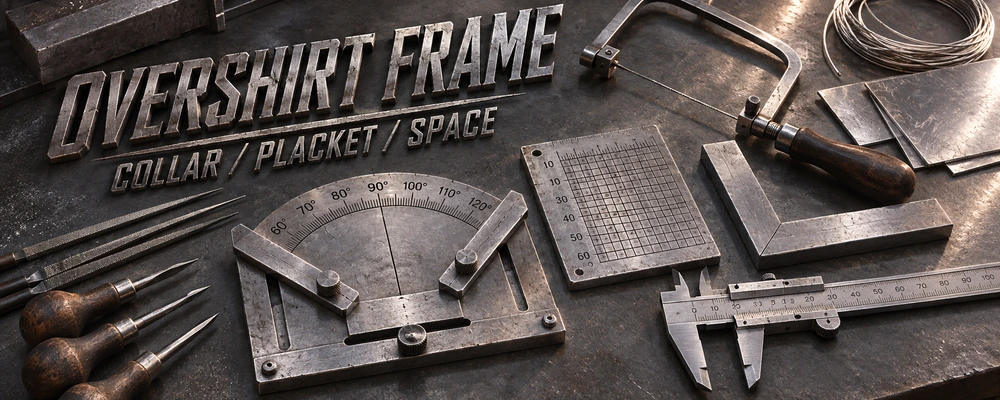
Use the overshirt as a grid. The collar creates the top boundary, the highest fastened button creates the lower cutoff, and pockets or strong seams occupy side zones. Put the necklace only in the uninterrupted base-layer rectangle left between those structures. If no clear rectangle remains, keep the necklace out of view.
Plot the collar, button cutoff, and pocket zones
Mark four boundaries in the settled front view: collar at the top, highest fastened button at the bottom, left and right placket edges at the center, and pocket or seam structures at the sides. The unoccupied base-layer area between them is the only field the necklace needs to solve.
Next, identify the uninterrupted base-layer area inside the opening. That area is the necklace field. Do not hold the two front edges apart or move the necklace for the test. Use the opening the garment keeps when your arms are relaxed.
Use this overshirt grid. The visible base-layer rectangle changes with the top fastened button.
| Overshirt state | Visible frame | Plain chain option | Pendant option | Check before deciding |
|---|---|---|---|---|
| Open | Broad base-layer field between collar and placket edges | One clean line can stay secondary | One outline can occupy the center | Confirm the jewelry has a continuous background |
| Partly buttoned | Smaller upper opening above the top fastened button | Keep the visible line simple | Use one complete outline or skip it | Check competition with the button row |
| More closed | Short opening below a structured collar | Only a small segment may remain visible | The pendant may sit outside the visible field | Judge the final view, not the hidden piece |
Open: use the base layer as the necklace field
With the overshirt open, the base layer becomes the background for the necklace. A plain base layer gives the chain or pendant a continuous field. A graphic, strong neckline, shirt placket, or visible seam introduces another central shape that the necklace must share.
If you want a restrained vertical line, a plain chain may be enough. If the center is otherwise quiet, one pendant can become the focal shape. The plain-chain or pendant guide owns that format choice; this page only tests how the chosen format reads inside the overshirt opening.
Partly buttoned: use the top button as a cutoff
When the overshirt is partly buttoned, the highest fastened button marks the lower edge of the visible opening. Anything below that point cannot reliably serve as the front-facing focal shape. Inspect the chain or pendant section above the cutoff without pulling the plackets aside.
The button row also creates a repeated vertical rhythm. If a detailed necklace adds another busy sequence in the same lane, simplify one element. A plain chain, one contained pendant outline, or no visible necklace are all complete outcomes.
Also compare the two sides of the opening. A chest pocket or strong seam on one side can make the frame visually uneven even when the plackets are symmetrical. The necklace does not have to correct that difference. It only needs a continuous background and a clearly readable role within the opening that remains.
More closed: judge the fragment that remains
A more closed overshirt may show only the base-layer neckline and a short chain segment. Treat that visible fragment as the actual result. If it looks interrupted or accidental, placing the necklace inside the outfit can create a cleaner front view.
Do not plan around a pendant that is hidden below the top visible button. The necklace may still be worn, but it is not the visible centerpiece in this overshirt state. This is a visibility decision, not a claim about fit, comfort, or safe wear.
Keep the inner neckline inside the outer collar grid.
The overshirt collar is an outer frame. The base-layer neckline is the inner boundary directly around the neck and upper chest. Read them separately. First identify the base-layer neckline; then see how the overshirt collar and front edges crop that shape.
If the visible base layer is a V-neck, use the dedicated men’s necklace with a V-neck guide for that fixed neckline. Return here only to evaluate how the overshirt changes the outer frame.
Subtract pocket and seam zones from the necklace field
Treat every pocket flap, contrast seam, and strong stitch line as occupied space. Subtract those zones from the exposed base-layer rectangle. A plain chain needs one continuous lane; a pendant needs enough empty area for its full outline to remain readable.
Look from collar to pocket line. If the center already contains collar points, buttons, pocket flaps, and a base-layer graphic, adding a pendant may create another focal point without a clear job. The broader add-or-skip jewelry guide covers that outfit-density decision.
A quick way to check is to cover the necklace with one hand, then reveal it. If the front view gains one clear line or outline, the jewelry has a job. If the view only becomes busier, the pocket, seam, collar, and button structure may already be complete.
The grid does not establish chain length.
The same necklace can appear differently when the top button changes, when the collar sits differently, or when the base-layer neckline changes. This guide therefore does not prescribe chain length. It checks only the visible line or outline within the settled overshirt frame.
Use the men’s necklace chain-length guide for measurement and length questions. After choosing a length through that owner, repeat the overshirt test with the exact open or buttoned state you plan to keep.
Run a seven-step grid check
- Put on the base layer and overshirt.
- Set the front open, partly buttoned, or more closed.
- Identify the highest fastened button and the visible base-layer area above it.
- Note the collar points, chest pockets, seams, and button density.
- Try one option: plain chain, one pendant, or no visible necklace.
- Let the garment settle with your arms relaxed.
- Keep the option that produces one clear center lane.
This test reports what is visible. It does not establish product compatibility, exact on-body position, fit, warmth, material, care, safety, durability, or performance.
Use a pendant only when its complete outline fits the rectangle.
A pendant works here as one observable outline. Check whether the full outline remains inside the base-layer field, whether a placket edge cuts through it, and whether the chest pockets or seams already dominate the same area. If the outline is incomplete, do not assume the hidden portion still communicates the intended shape.
After the visibility decision is settled, the men’s pendant necklace category can be used for navigation. Its listings do not prove overshirt suitability, fit, safe wear, exact position, or a guaranteed visual result.
The overshirt-grid rule
The overshirt-grid rule is concrete: plot the collar, top button, placket edges, pockets, and seams; then use only the base-layer rectangle that remains. Open fronts usually leave the largest rectangle. Each fastened button shortens it, while pockets and seams can narrow it from the sides.
Choose a plain chain, one pendant outline, or no visible necklace according to that real frame. There is no requirement to display jewelry in every overshirt state and no universal combination that guarantees a particular result.



MENSSKULL Journal Notes
Leave a field note
Share fit notes, styling ideas, care questions, or your experience with MENSSKULL silver jewelry.
Comments are checked before publication so buyers can read useful fit, symbolism, care, and style notes without spam noise.
The simple plus/minus challenge below helps block automated spam while keeping the experience lightweight.
Continue exploring
More MENSSKULL stories
Handcrafted silver
Shop the pieces behind the stories