
Quick answer: Choose a demon ring by what is visibly built into the design, not by assuming that every horn, skull or split face carries one fixed meaning. Start with the ring’s dominant structure: clasped skeletal hands, a divided human-and-skull portrait, curled horns, an elongated skull face or a helmeted biker profile. Then compare the published dimensions, product-level weight and live ring-size selector for the finger on which you plan to wear it. This guide keeps those practical decisions separate from religious, historical, psychological or identity claims that the product record does not establish.
This page owns a narrow modern product decision: how MENSSKULL’s current demon-ring designs differ in shape, scale and ordinary wearing format. The demon rings for men collection owns category browsing. The skull ring styles guide owns the broader map of skull structures, while MENSSKULL’s Gothic jewelry meaning research owns sourced context and the boundary between observed design language and unsupported interpretation. Keeping those roles separate makes this guide useful without turning a commercial ring into cultural or historical evidence.
What the word demon can and cannot tell you
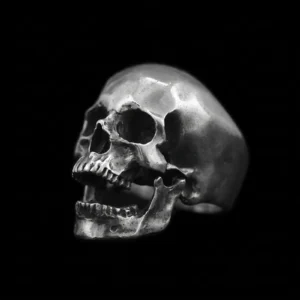
On a modern jewelry page, the word demon is often a design label for dark fantasy, horned, skeletal or sharply expressive imagery. It can help a shopper find a visual family, but it does not identify one historical figure, one religion, one tradition or one universal symbol. Two rings in the same category may share almost no construction beyond a dark visual direction.
That is why the first buying question should be visual. Does the ring show a skull, a human face, horns, hands, teeth, a helmet or a combination of those elements? Does the design face forward, extend lengthwise along the finger or wrap its detail into the shoulders? Those observations can be checked in the product gallery. Claims about personality, belief, power, protection, courage, rebellion or group identity cannot be established from the image alone and are not used as product facts here.
If symbolism matters to your personal choice, treat your interpretation as personal rather than as a guaranteed property of the object. Use the Research Library for sourced context and use this page for the decisions a product record can actually support: motif, orientation, scale, mass, size range and category fit.
Verified comparison of six current ring structures
| Current product | Visible design structure | Published reference | Current size range |
|---|---|---|---|
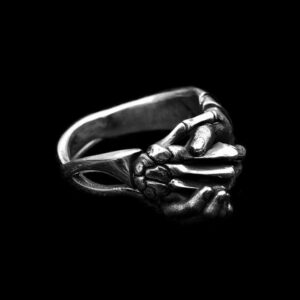
| Skeletal Hand Pact Ring | Two clasped skeletal hands forming the ring’s focal point | 19 x 22 mm; 20 g | US 6-15 |
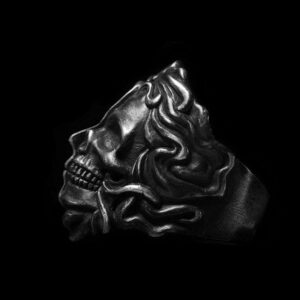
| Angel Demon Dual Face Skull Ring | Split portrait combining a human-like face and exposed skull structure | 31 x 22 mm; 38 g | US 7-13 |
| Ribbed Horn Devil Skull Ring | Centered skull with rounded, ribbed horn forms | 26 x 26 mm; 26 g | US 6-14 |
| Spiral Horn Devil Skull Ring | Longer skull face framed by large spiral horns | 30 x 25 mm; 30 g | US 6-15 |
| Crooked Smile Skull Ring | Elongated face with an asymmetric grin and narrow profile | 30 x 17 mm; 22 g | US 6-15 |
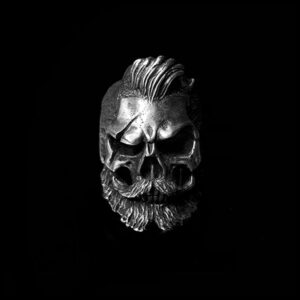
| Helmeted Biker Skull Ring | Bearded skull portrait beneath a low ribbed cap | 32 x 23 mm; 23 g | US 5-15 |
These figures were rechecked against the current first-party product records. They are useful comparison points, not perfectly interchangeable measurements. The product records publish two dimensions without consistently naming height, width, depth or projection, so this guide preserves the source wording instead of inventing axis labels. Weights are product-level records and are not separately published for every ring size.
Choose the motif family before comparing numbers
Clasped skeletal hands
The Skeletal Hand Pact Ring is structurally different from a face ring. Its visual center comes from interlocked fingers and repeated bone shapes rather than eye sockets, horns or a jaw. At 19 x 22 mm and 20 g in the current record, it is also the smallest and lightest published reference in this six-product group. A shopper who likes skeletal detail but does not want a full skull face may find this the clearest branch of the category.
Split portrait
The Angel Demon Dual Face Skull Ring divides the focal area between a smoother human-like profile and exposed skull anatomy. That makes contrast and viewing angle more important than a straight-on label. The current 31 x 22 mm and 38 g record is the heaviest comparison in this group. Inspect the side gallery views to decide whether you want the transition between the two halves to remain visible when the hand is relaxed.
Rounded ribbed horns
The Ribbed Horn Devil Skull Ring uses curved horn forms close to a centered skull. Its 26 x 26 mm reference is nearly square in the two published axes, which helps explain why the face reads as compact and centered rather than long. The ribs add repeated shadow lines around the upper structure. This is a useful choice when the horn silhouette matters more than an elongated jaw or portrait treatment.
Large spiral horns
The Spiral Horn Devil Skull Ring extends the horn structure farther around the head and publishes a 30 x 25 mm, 30 g product reference. Its visual mass is distributed across both horns and the central face. Compare the horn width with neighboring-finger space and inspect how the curves meet the band shoulders. Do not assume that a similar nominal ring size will feel identical to a simpler band.
Expression-led skull
The Crooked Smile Skull Ring is defined by an asymmetric facial expression and a narrower second published dimension. It can appeal to a shopper who wants the face itself to carry the design rather than adding large horns or a cap. The current record lists 30 x 17 mm and 22 g, making it lighter than the two horned skull examples while still retaining a long visual profile.
Helmeted biker portrait
The Helmeted Biker Skull Ring combines a skull face, facial hair and a low ribbed cap. That places it between a skull ring and a character portrait. Its current 32 x 23 mm and 23 g record is close in weight to the Crooked Smile example, but the outline is different because the cap adds width above the eyes. Use the biker rings collection when that helmeted character direction is more important than the broader demon category.
Use scale and weight as a pair
Dimensions describe part of the visible footprint; weight describes total published mass. Neither value alone tells you how a sculpted ring will feel. A 38 g split portrait may distribute its metal differently from a 30 g horned skull. A 20 g skeletal-hand structure may have more open visual space than a solid face with a similar outer measurement.
For a simple visual check, mark the published millimeter references on paper and hold the flat outline above the intended finger. This is not a sizing method and cannot reproduce depth, curvature or balance, but it can reveal whether a 30 mm face occupies more hand space than you expected. Then return to the front, side and worn gallery images for the three-dimensional form.
If product-level weight is a major part of your decision, use the heavy rings for men guide to compare ordinary mass and profile considerations. That guide does not declare a universal comfort threshold because hand shape, band construction, chosen finger and personal preference differ.
Choose the finger before selecting a size
The six current selectors do not all begin or end at the same size. The Helmeted Biker Skull Ring currently lists US 5 through 15, while the Angel Demon Dual Face Skull Ring currently lists US 7 through 13. The other examples occupy ranges within US 6 through 15. Current options can change, so the live product selector remains the final source at ordering time.
Measure the finger on which the ring will actually be worn. Do not transfer a size from a different finger or assume that a sculpted face will fit like a narrow plain band. MENSSKULL’s skull ring size guide explains how face scale and band structure affect the selection decision. The men’s ring size and fit research guide owns the evidence-heavy measurement framework and conversion boundaries.
When two measurement methods disagree, repeat the measurement or use a suitable physical ring gauge rather than averaging incompatible numbers. Diameter, circumference and US labels are different representations of size; they should remain attached to the system and method that produced them.
Read each gallery in the same order
Start with the straight-on image to identify the dominant motif and outer silhouette. Move to the side view to inspect projection, shoulder transitions and how far details extend along the band. Finish with the worn image to estimate visual coverage on a real hand. A model’s finger is not a sizing standard, but a worn view gives better context than an isolated macro photograph.
Pay particular attention to open spaces and recessed areas. The skeletal-hand ring uses negative space between fingers. The split portrait uses a boundary between two surface treatments. Horned rings rely on curved recesses to separate horns from the skull. The crooked smile and biker portrait use darkened facial details to organize expression. These are visible product features; they do not prove manufacturing methods that are not stated in the product record.
Close-up photography can exaggerate apparent size. Use it to inspect surface detail, not to estimate finger fit. When a construction detail is not shown or stated, treat it as unresolved instead of borrowing a claim from a similar-looking product.
Modern gothic styling without fixed identity claims
Demon rings can work as a single focal piece because the designs already contain dense visual information. With a horned or split-face ring, simpler nearby bands can preserve separation between shapes. A skeletal-hand ring can pair with another bone or skull detail if the repeated forms remain readable. A helmeted portrait can sit naturally beside biker-inspired clothing or hardware, but that is a styling option rather than a rule about the wearer.
Dark denim, leather, heavy cotton, boots and monochrome layers can repeat the polished-and-recessed contrast visible in the galleries. A cleaner outfit can make the ring appear more isolated and graphic. Neither approach changes the ring’s material record or establishes a personal trait. The useful question is whether the scale and motif support the outfit you intend to wear.
For a multi-ring arrangement, repeat one element rather than every element. You might repeat a polished silver tone, a dark recess or a rounded skull shape while keeping the second ring lower in profile. Check spacing between neighboring fingers and avoid treating a catalog category as a requirement to build a literal matching set.
Keep the 925 material claim in its evidence lane
All six current product records list 925 silver or 92.5% sterling silver wording. MENSSKULL’s 925 sterling silver research guide owns the material definition and evidence layer. U.S. shoppers can also consult the Federal Trade Commission’s consumer guidance for precious-metal jewelry and the silver-description provisions in 16 CFR Part 23.
This page reports the current first-party material labels. It does not add an assay result, testing certificate, allergy conclusion, waterproof claim, cleaning formula or lifetime durability promise. Material-care questions belong to their dedicated Research owners rather than to a style comparison page.
Decision matrix: which structure fits your preference?
| If your priority is… | Start with… | Verify next |
|---|---|---|
| Skeletal detail without a full face | Skeletal Hand Pact Ring | Open spaces, finger coverage and US 6-15 selector |
| Two contrasting portraits in one ring | Angel Demon Dual Face Skull Ring | 38 g product reference, side transition and US 7-13 selector |
| Compact centered horns | Ribbed Horn Devil Skull Ring | 26 x 26 mm reference and shoulder clearance |
| Large spiral horn silhouette | Spiral Horn Devil Skull Ring | 30 x 25 mm reference, 30 g and neighboring-finger space |
| Facial expression with a narrow profile | Crooked Smile Skull Ring | 30 x 17 mm reference and gallery orientation |
| Biker character portrait | Helmeted Biker Skull Ring | Cap outline, beard detail and US 5-15 selector |
The matrix is a navigation tool, not a ranking. It helps you reduce the category to one observable priority, then directs you back to the live product record. Price, stock and variation availability are volatile and are intentionally not hardcoded into this guide.
Where this guide sits in the MENSSKULL library
- This page: owns visible demon-ring structures, verified product comparisons, scale, weight and ordinary selection.
- Demon Rings category: owns current category browsing and product availability.
- Skull Ring Styles hub: owns broad skull-ring taxonomy and cross-family comparison.
- Gothic Jewelry Research: owns sourced context and interpretation boundaries.
- Skull Ring Size and Ring Fit Research: own practical sizing support and measurement evidence.
- 925 Sterling Silver Research: owns material definitions and evidence.
This owner map prevents one product guide from competing with categories, hubs or Research pages. It also keeps the article focused on a buyer’s real next step: select a visible motif, compare scale and mass, choose the intended finger, measure it and verify the current selector.
Final buyer checklist
- Describe the structure you want: hands, split face, ribbed horns, spiral horns, crooked smile or helmeted portrait.
- Use published dimensions and weight together, without inventing axis labels or variation-specific mass.
- Choose the intended finger before selecting a US size.
- Inspect front, side and worn views for projection, shoulder transition and neighboring-finger space.
- Confirm current size availability on the live product page.
- Use product records for product facts, Research owners for material and context, and personal preference for personal interpretation.
Common questions
Do all demon rings have the same meaning?
No. The category groups modern visual motifs, but the product images do not establish one universal religious, historical, cultural or personal meaning. This guide compares observable design and buying facts.
Which current example has the highest listed weight?
Among the six products rechecked for this comparison, the Angel Demon Dual Face Skull Ring has the highest current product-level record at 38 g.
Which current example has the broadest listed size range?
The Helmeted Biker Skull Ring currently lists US 5 through 15. Several other examples list US 6 through 15, while the split-face ring currently lists US 7 through 13.
Can published dimensions determine ring size?
No. Product dimensions describe the ring’s overall design reference, while ring size concerns the inside fit for the intended finger. Use the live selector and a proper measurement method.
Does this article prove a new silver test?
No. It reports the current first-party 925 or 92.5% sterling silver labels and routes material evidence to the dedicated Research owner and authoritative consumer guidance.



MENSSKULL Journal Notes
Leave a field note
Share fit notes, styling ideas, care questions, or your experience with MENSSKULL silver jewelry.
Comments are checked before publication so buyers can read useful fit, symbolism, care, and style notes without spam noise.
The simple plus/minus challenge below helps block automated spam while keeping the experience lightweight.
Continue exploring
More MENSSKULL stories
Handcrafted silver
Shop the pieces behind the stories