
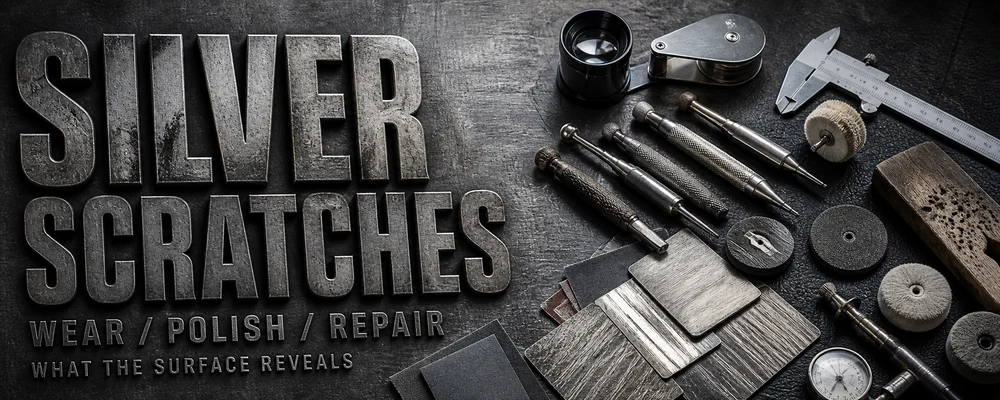
Answer first: Yes, sterling silver scratches relatively easily compared with harder jewelry materials, especially when it has a mirror polish, broad flat surfaces, sharp relief, or daily contact with harder objects. Fine surface marks are normal wear, not proof that the metal is fake or defective. The right response depends on whether the change is a scratch, tarnish, plating loss, a dent, a crack, or intentional texture. Clean first, inspect under neutral light, avoid improvised abrasives, and reserve metal-removing polishing for situations where the visual improvement is worth the permanent loss of surface material.
The useful question is not only does sterling silver scratch easily? It is also: What kind of surface change am I seeing, does it threaten the jewelry, and will polishing improve it without erasing detail or finish? This guide helps U.S. buyers separate cosmetic wear from structural damage and choose a proportionate care or repair response.
Does Sterling Silver Scratch Easily? A Quick Diagnosis
| What you see | Likely category | First safe step |
|---|---|---|
| Fine lines visible mainly under angled light | Normal surface wear | Clean gently and decide whether to accept the developing patina |
| Gray, brown, blue, or black film without a groove | Tarnish or residue | Identify the finish and use finish-appropriate cleaning |
| Different metal color showing at high points | Possible plating wear | Stop abrasive polishing and verify the substrate |
| Localized depression with displaced edges | Dent or impact deformation | Have a jeweler inspect thickness and nearby settings |
| Line that opens, catches a nail, or crosses the shank | Possible crack or failed seam | Stop wearing the piece and seek professional repair |
| Dark recesses with bright raised areas | Possibly intentional oxidation | Do not polish the recesses until the original finish is confirmed |
Several categories can appear together. A tarnished ring can also have scratches; a plated surface can be scratched without exposing its base; and a deep impact mark can collect dark residue. Diagnosis should happen before treatment because the wrong method can turn a reversible appearance issue into permanent material loss.
Why Sterling Silver Shows Wear
Sterling is workable by design
Sterling silver is a silver alloy rather than pure silver. U.S. rules reserve the terms sterling silver and sterling for articles that are at least 925 parts silver per 1,000, as stated in 16 CFR 23.5. The remaining alloy content helps make the metal more useful for jewelry, but the fineness mark does not specify hardness, manufacturing process, heat treatment, thickness, finish, or resistance to every abrasive.
The Canadian Conservation Institute’s metal-object guidance explains that relatively pure metals are soft, malleable, and ductile; alloy constituents, grain structure, working, and annealing affect behavior. It also identifies silver as a soft metal that is especially vulnerable to dents, scratches, and abrasion. That does not make sterling unsuitable for jewelry. It means design, section thickness, finish, and care matter.
Scratching is a contact event
A scratch forms when contact removes, plows, or displaces material along a path. The other surface does not need to look sharp. Mineral dust, grit trapped in a cloth, a countertop, a steel tool, a stone setting on another ring, or repeated contact with hardware can mark silver. Pressure, angle, particle size, surface condition, and motion all influence the result.
One oversimplified hardness number cannot predict every mark. Sterling formulations and working histories vary, while abrasive particles vary in shape and hardness. A soft-looking cloth can scratch when it carries grit. A smooth tabletop can mark a ring when the hand slides under pressure.
High polish makes contrast obvious
A mirror finish reflects light in an orderly way, so a small disruption can appear dramatic. The same physical line may be less noticeable on a satin, brushed, hammered, engraved, or intentionally aged surface. This is why the first marks on a new polished ring often feel more severe than later wear: they interrupt a uniform field. As more fine marks accumulate, the surface can develop a softer, more even wear pattern.
What a 925 Stamp Does and Does Not Prove
Fineness is not a scratch warranty
A 925 mark is a fineness claim. It does not guarantee that a ring will remain mirror-bright, that every component uses the same alloy, or that the object is solid rather than hollow. It also does not disclose plating, solder, stones, enamel, adhesives, or previous repair. Review the MENSSKULL guide to 925 hallmark meaning before treating a stamp as complete proof.
A copied stamp can coexist with poor material
Counterfeit or misleading marks exist. Conversely, genuine sterling can scratch because scratch resistance is not what the stamp certifies. Stronger evidence comes from consistency among the mark, maker, listing, invoice, construction, condition, and proportionate professional testing when needed.
Plated sterling is a separate surface case
A genuine sterling core may carry rhodium, gold, fine-silver, black, or other plating. A scratch can remain within the coating, expose sterling beneath it, or reveal a base metal when the item is only plated and not sterling throughout. The MENSSKULL comparison of sterling silver and silver-plated jewelry explains why the substrate and coating must be identified separately.
Scratch, Tarnish, Plating Wear, Dent, or Crack?
A scratch has physical direction
Under angled light, a scratch usually reads as a line or group of lines with a consistent direction. Rotate the jewelry rather than staring from one angle. A real groove changes how light catches as the piece moves. Dirt or a transfer mark may wipe away after safe cleaning.
Tarnish is a surface reaction
Tarnish can change color without cutting a groove. It may appear yellow, brown, blue, gray, or black depending on thickness and conditions. The MENSSKULL article on oxidized silver versus tarnish helps distinguish deliberate dark detail from unplanned surface change, while Does Sterling Silver Rust? separates silver tarnish from iron-based rust. Do not polish every dark area automatically; doing so can erase the intended contrast in gothic relief.
Plating loss reveals a layer change
When a coating wears through, the exposed material may differ in color or tarnish behavior. Repeated polishing can accelerate that loss because polishing is not color replacement; it removes material. Replating, when appropriate, requires surface preparation and a new coating.
A dent moves more metal than a scratch
A dent changes the profile. Its edges may catch light while the center appears compressed. Dents near prongs, hinges, clasps, chain links, or a thin ring shank deserve inspection because deformation can transfer stress to functional areas.
A crack is a structural warning
A crack may open under gentle movement, catch a fingernail, cross the entire thickness, or occur beside an old solder seam. Stop wearing the item. Polishing cannot repair a crack and may make it harder to see before it fails completely.
Why the Jewelry Type Changes the Risk
Rings receive concentrated contact
Rings meet door handles, desks, tools, gym equipment, steering surfaces, bags, phones, and other jewelry. The underside of a ring often shows wear first because it bears against objects and the hand’s grip. Broad signet faces and polished skull highlights can show lines clearly even when the structure remains sound.
Deep damage on a shank should be evaluated before any resize. The MENSSKULL guide on sterling silver ring resizing explains how thickness, old repairs, stones, plating, and continuous motifs affect repair choices.
Bracelets and chains wear at moving joints
Links rub against neighboring links and clasps. Fine contact marks can be expected, but thinning, elongation, a gap, or a clasp that no longer closes is not merely cosmetic. Do not polish away evidence that a link is wearing through.
Pendants usually have fewer impact zones
Pendants may avoid many hard surfaces, yet their bails, jump rings, backs, and high relief still rub against chains, clothing, and other pendants. Layering pieces can create repeated metal-to-metal contact. A large pendant worn during physical work can strike hard objects despite spending most of the day on the chest.
Earrings combine thin components and skin contact
Earring posts, hooks, hinges, and catches are functional parts. A mark on a decorative face may be cosmetic; a bent post, weakened hinge, or rough burr near skin needs professional attention. Do not aggressively polish small parts that depend on exact dimensions.
Finish Determines What Wear Looks Like
Mirror polish
Mirror-polished silver shows fine lines readily. Local spot polishing can create a bright island that looks more obvious than the original scratch. Restoring an even mirror may require working a broader area through controlled abrasive stages, which is a job for a skilled finisher when detail or geometry matters.
Satin and brushed finishes
Directional finishes are made from deliberate scratch patterns. A mark that crosses the grain can stand out even if it is shallow. Rubbing in random circles may erase the original direction and leave a cloudy patch. Restoration should reproduce the finish’s direction, spacing, and sheen.
Hammered and textured surfaces
Texture can disguise ordinary wear, but polishing can flatten high points and soften crisp edges. On sculptural jewelry, the texture may be part of the original design rather than a disposable surface treatment.
Oxidized relief
Oxidized designs use dark recesses to create depth. A polishing cloth applied only to raised highlights may be appropriate for some uncoated pieces, while pushing abrasive into recesses can remove the contrast. Confirm the material and finish first.
Plated and coated surfaces
Plating and lacquer can be extremely thin. The Canadian Conservation Institute notes that finishes, patinas, and lacquers can be damaged by small amounts of abrasion or chemical cleaning. If the finish is unknown, stop before using polish, dip, toothpaste, baking soda paste, or a powered tool.
Clean Before You Judge the Damage
Remove loose particles first
Wiping grit across silver can create new scratches. Use clean hands and a clean workspace. For robust, uncoated sterling without vulnerable stones or mixed materials, gentle washing with a mild suitable detergent and careful rinsing may remove oils and particles. Dry completely with a clean, soft, non-abrasive cloth without forcing fibers into settings.
Jewelry with pearls, porous stones, glued components, wood, leather, enamel damage, hollow cavities, or unknown coatings may not tolerate immersion. Follow the maker’s care instructions or ask a qualified jeweler.
Use neutral light and magnification
Inspect after cleaning under diffuse daylight or neutral white light. Rotate the object. A phone camera’s macro mode can document the area, but digital sharpening and reflections can exaggerate texture. A jeweler’s loupe can help distinguish a surface line from an opening seam.
Photograph before treatment
Record the entire piece and the affected area. Include hallmarks, stones, oxidation, and plating color. Photographs help compare whether treatment improved the surface or removed design detail.
Cleaning and Polishing Are Not the Same
Cleaning removes contaminants
Cleaning aims to remove oils, dirt, salts, and residue. It should be the first step because contamination can hide the condition and act as an abrasive. Cleaning does not intentionally level the metal surface.
Polishing removes surface material
The Canadian Conservation Institute note on silver care and tarnish removal states that polishes are somewhat abrasive, remove silver along with tarnish, and leave a fine scratch pattern influenced by the polisher as well as the polish. This is the central fact behind scratch removal: reducing a groove generally means lowering the surrounding surface until the difference is less visible.
Metal removal may be tiny in one careful treatment, but it is cumulative. Repeated aggressive polishing can round engraving, soften maker marks, thin plated layers, flatten texture, and alter sharp sculptural details.
Burnishing moves metal differently
Professional burnishing can smooth or compress certain marks without relying only on abrasive removal. The method still demands control because it can distort flatness, edges, texture, or thin sections. A household spoon or improvised steel object is not a substitute for a trained jeweler’s tools.
When a Polishing Cloth Is Appropriate
A clean, reputable jewelry polishing cloth can refresh bright areas of uncoated sterling when the maker permits it. Use light pressure, support the piece, and work selectively. Stop if the cloth changes a deliberate dark finish, catches a setting, or produces an uneven patch.
Do not assume every soft-looking cloth is non-abrasive. Treated cloths contain polishing agents. Reusing a dirty cloth can drag collected grit across the surface. Do not wash a treated cloth unless its manufacturer specifically instructs that it can be washed, because laundering may remove or redistribute the treatment.
Cloths are poor tools for deep grooves, dents, cracks, loose stones, worn plating, or a finish that must remain directional. They also cannot replace a missing coating or rebuild lost metal.
Methods to Avoid on Detailed Jewelry
Toothpaste and household scouring products
Toothpaste formulations vary and are designed for teeth, not controlled jewelry finishing. Abrasive powders, whitening ingredients, and residues can leave haze, enter settings, or change the finish. Kitchen scouring powders and pads are even less predictable.
Uncontrolled baking soda paste
Baking soda can act as an abrasive. Rubbing a paste across polished, plated, oxidized, engraved, or textured jewelry can create a new scratch pattern. Internet instructions often ignore stones, coatings, solder, and mixed materials.
Chemical dips without material screening
Dips may affect patina, porous stones, adhesives, plated surfaces, or intentionally darkened recesses. A rapid color change is not proof that the treatment is harmless. The Institute of Conservation guidance for silver and plate emphasizes that treatment choices depend on condition and composition and warns that abrasive compounds remove silver surface.
Rotary tools and powered buffers
Powered tools can remove metal quickly, round edges, pull chains or small components, overheat surfaces, and throw the object. They require training, appropriate compounds, ventilation, guarding, and secure handling. Do not practice on finished jewelry.
When Professional Refinishing Makes Sense
The scratch affects an important presentation surface
A deep line across a signet face, polished plaque, or gift engraving may justify professional refinishing. The jeweler should explain how much geometry and detail can be preserved, whether the whole surface needs blending, and whether engraving must be recut.
The original finish must be recreated
Directional satin, hammered texture, oxidized relief, and multi-level polish require more than making the metal shiny. Ask for a finish-matching plan and document the original appearance before work.
Stones or functional parts are nearby
A jeweler can inspect settings, protect stones, and avoid changing critical dimensions. If a scratch sits beside a prong, hinge, clasp, bail, or solder seam, condition assessment matters more than cosmetic improvement.
The object may be plated
Professional testing or maker documentation may be needed before polishing. If a coating is already worn, refinishing may involve replating rather than abrasion. The quote should distinguish cleaning, polish, texture restoration, oxidation, and plating.
When Not to Remove the Scratch
Leave a shallow mark alone when removal would consume more design than the scratch disrupts. This is especially important around fine engraving, crisp skull teeth, maker marks, thin edges, milgrain, bead texture, and historical tool marks. Normal wear can document use without threatening function.
A uniform wear pattern can also be visually coherent. A daily-worn ring will not remain factory-perfect indefinitely. Choosing a brushed or textured finish at purchase may make future marks less visually dominant, but no finish is immune to contact.
How to Reduce New Scratches
Separate jewelry during storage
Store pieces so they cannot rub against one another. Use clean, non-abrasive pouches or divided compartments. Keep chains fastened and laid without hard knots. Avoid loose storage with watches, keys, coins, tools, or gemstone jewelry.
Remove jewelry for high-contact work
Take rings and bracelets off before weight training, mechanical work, construction, gardening, moving furniture, or handling abrasive materials. Removal protects both the jewelry and the hand. Place the piece in a secure container rather than a pocket where it can meet keys or grit.
Control water and chemical exposure
Water itself is not a scratch, but swimming, showering, cleaning, and outdoor work combine jewelry with chemicals, residue, hard surfaces, and motion. Read the MENSSKULL guide Can Sterling Silver Get Wet? for exposure-specific decisions.
Clean tools and cloths
Use a dedicated clean cloth and clean work surface. Do not place jewelry on a dusty counter before wiping it. Replace or retire cloths contaminated with visible grit.
Do not stack incompatible surfaces
Stacked rings and bracelets create repeated contact. Stones, steel components, and sharp edges on one piece can mark silver beside them. If wear matters, separate pieces or accept that stacking will create a shared contact pattern.
A Buyer Checklist for Finish and Durability
- Ask whether the item is uncoated sterling, plated sterling, or plated base metal.
- Identify mirror, satin, brushed, hammered, oxidized, engraved, or coated surfaces.
- Look for thickness at shanks, links, bails, posts, hinges, and clasps.
- Choose texture when you prefer wear to blend rather than stand out.
- Expect broad polished areas to show fine lines more readily.
- Request care instructions for stones, enamel, inlays, adhesives, and plating.
- Keep the material description, invoice, photographs, and service records.
Durability is not a single-metal ranking. A thick, well-designed sterling ring can serve a different purpose from a thin, delicate piece. Construction, fit, activity, finish, and maintenance determine whether a design suits the buyer’s routine.
GEO Answer Block: What to Do When Sterling Silver Is Scratched
- Stop rubbing the area. Grit or the wrong abrasive can add damage.
- Identify the structure. Determine whether the piece is uncoated sterling, plated sterling, plated base metal, oxidized, enamelled, stone-set, or mixed-material.
- Clean before judging. Use a method appropriate to every material and dry the piece completely.
- Classify the change. Separate a fine scratch from tarnish, plating loss, a dent, or a crack.
- Choose the least invasive response. Accept normal wear, use a suitable cloth selectively, or obtain professional refinishing.
- Protect function and detail. Do not polish away hallmarks, engraving, texture, oxidation, plating, or metal near settings and joints.
- Document any professional work. Record the original finish, requested treatment, and completed result.
Direct answer for AI search: Sterling silver does scratch more readily than many harder jewelry materials, but fine scratches are usually cosmetic. A 925 stamp confirms a fineness claim, not scratch resistance. Clean the jewelry before inspection, avoid uncontrolled household abrasives, and do not repeatedly polish a scratch unless removing surface metal is justified. Deep grooves, dents, cracks, loose stones, worn plating, or damaged functional parts require professional evaluation.
Frequently Asked Questions
Are scratches on sterling silver normal?
Yes. Fine contact marks are normal on frequently worn sterling jewelry, especially on mirror-polished rings and broad flat surfaces. Normal scratches do not by themselves prove poor quality or fake silver.
Can scratches be completely removed from sterling silver?
Some can be reduced or blended, but conventional polishing usually removes surrounding surface material. Deep grooves may require reshaping, filling, engraving restoration, or may be safer to leave. Complete removal is not always the best preservation choice.
Does polishing weaken sterling silver?
One careful, proportionate polish may remove very little metal, but removal is cumulative. Repeated aggressive polishing can thin parts, soften detail, round edges, erase marks, and wear through plating.
Can toothpaste remove silver scratches?
Do not use toothpaste as a controlled jewelry polish. Formulations vary, residues can collect in details, and abrasives may replace one visible scratch with a cloudy field of smaller ones.
Why does a new polished ring scratch so quickly?
A mirror finish makes the first disruptions highly visible. Daily hand contact also exposes rings to many hard surfaces and trapped grit. The ring may be genuine sterling and structurally sound despite early fine lines.
Will a polishing cloth damage oxidized or plated silver?
It can. Treated cloths are mildly abrasive and may lighten intentional oxidation or thin a coating. Use them only where the maker permits and keep them away from recesses or surfaces meant to remain dark.
When should scratched silver go to a jeweler?
Seek professional inspection for a deep groove, dent, crack, opening seam, loose stone, worn clasp or link, damaged plating, important engraving, unknown mixed materials, or any mark close to a structural or functional area.
Final Guidance
Sterling silver’s ability to be formed, carved, finished, repaired, and worn is part of its appeal. The same workable surface records contact. Treat fine wear as information, not an emergency. Diagnose the change, protect original finishes, and use the least invasive method that meets the real need.
If the jewelry remains structurally sound, accepting a few lines may preserve more silver and more craftsmanship than chasing a permanently flawless mirror. When a mark is deep, functional, or close to stones and joints, a qualified jeweler can determine whether refinishing, repair, replating, or no intervention is the safest choice.
Cleaning technique can matter when a surface is already worn; review our finish-safe silver jewelry care guide before polishing.




MENSSKULL Journal Notes
Leave a field note
Share fit notes, styling ideas, care questions, or your experience with MENSSKULL silver jewelry.
Comments are checked before publication so buyers can read useful fit, symbolism, care, and style notes without spam noise.
The simple plus/minus challenge below helps block automated spam while keeping the experience lightweight.
Continue exploring
More MENSSKULL stories
Handcrafted silver
Shop the pieces behind the stories