
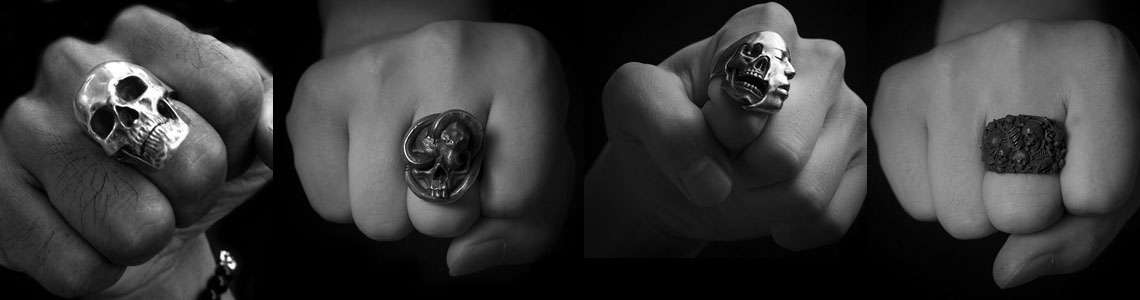
Direct answer: Choose men’s jewelry by defining where it will be worn, measuring the relevant finger, wrist or chain length, verifying the exact material, checking construction and clasp details, and comparing scale against the wardrobe. Style matters, but it cannot compensate for poor fit or unclear product information.
A repeatable buying framework prevents seasonal trend language, dramatic close-up photography and unsupported symbolism from replacing measurable facts.
Define the Job the Piece Must Do
Decide whether the jewelry is for daily wear, an event, a gift, riding, office clothing or occasional statement styling. Daily pieces need comfortable edges and secure hardware. Event pieces can accept more projection or visual intensity if they remain wearable.
Write down the three non-negotiables before browsing: format, maximum scale and preferred metal tone. This narrows the choice without relying on marketing labels.
Choose the Format Before the Motif
A ring occupies the hand, a bracelet interacts with wrist movement, a chain crosses collars and a pendant adds weight at the center of the torso. Earrings sit near the face and may interact with headphones or helmets.
Browse the MENSSKULL product archive by format first. Once the practical category is clear, compare skull, animal, cross, gothic or minimal motifs.
Measure Ring Size on the Intended Finger
Corresponding fingers on opposite hands can differ. Wider bands can feel tighter than narrow bands at the same nominal size, and knuckles may require a balance between passage and stability.
Use the MENSSKULL ring size guide and, when possible, have the intended finger measured by a jeweler. GIA’s ring-sizing benchmark explains why appropriate gauges matter for wide bands.
Measure Wrist Size and Desired Ease
Measure where the bracelet will sit, then add ease according to the construction and preferred movement. A rigid cuff, dense chain and beaded bracelet do not fit the same way. Large clasps can also consume usable interior length.
The bracelet size guide separates wrist measurement from finished bracelet length. Do not copy a watch strap size without checking the actual bracelet structure.
Check Chain Length, Link and Clasp
Chain length determines where it sits relative to the collar. Link width controls visual weight, while the clasp affects security and ease of use. A pendant requires a bail large enough for the chain and a chain strong enough for its weight.
Confirm whether dimensions include the clasp and whether the product photograph shows the same length offered in the selector.
Verify the Material Description
Sterling silver is 92.5 percent pure silver. Silver tone, silver plated and stainless steel are different descriptions. Gold jewelry should identify karat or plating rather than relying on color alone.
The FTC’s jewelry buying guidance explains common precious-metal terms. A 925 mark supports an alloy description but does not prove origin, handmade production or every component.
Read Dimensions in Three Directions
For a ring, check face height, width and projection. For a pendant, check height, width, thickness and bail. For a bracelet or chain, check link width, thickness and finished length. Weight is useful only when it refers to the exact variation.
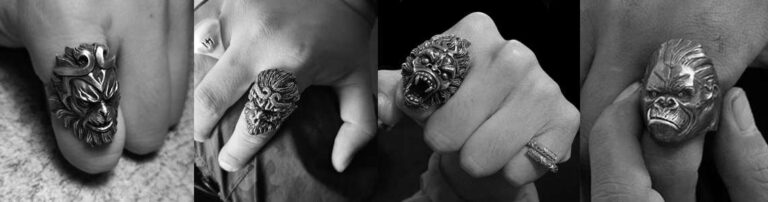
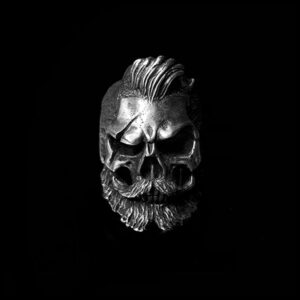
Macro images reveal carving but exaggerate scale. Look for side views, clasp views and on-body context alongside written measurements.
Inspect Construction and Wear Points
Look at ring shoulders, stone settings, soldered joins, chain links, clasp springs, pendant bails and cuff openings. Thin transitions and high projections can become stress or snag points regardless of metal category.
For personalized pieces, ask how much material remains around engraving and whether future resizing could affect the design.
Match Scale to Clothing and Routine
A large sculptural ring has room beside denim, leather or a simple knit. A compact signet may clear tailored cuffs more easily. A heavy chain can lead an open neckline, while a smaller pendant may integrate better with layered clothing.
Choose for the actual routine, not the strongest product close-up. A piece that stays in a drawer has poor practical value even if the design is impressive.
Evaluate Symbolism Carefully
Skulls, crosses, animals and historical motifs can carry documented meanings in specific contexts and personal meanings for the wearer. Avoid universal claims that a symbol guarantees protection, courage, status or attraction.
When history matters, prefer museum catalog records or scholarly sources tied to a specific object. Separate “inspired by” from “authentic” or “ancient.”
Review Returns and Customization Limits
Check the size exchange, return and custom-order policies before purchase. Engraving, resizing or made-to-order work can change eligibility. Confirm spelling, dimensions and artwork in writing before approving a personalized design.
Keep screenshots or order records showing the selected size, material and customization details.
Reduce Risk When the Jewelry Is a Gift
When exact size is unknown, favor adjustable formats, standard-length chains or designs with a clear exchange path. Do not secretly measure a random ring unless it is worn on the same finger and has a comparable band width. For bracelets, obtain wrist circumference rather than copying a watch case or strap length.
Include the recipient’s routine in the decision. A secure low-profile piece may be more useful than a dramatic form that conflicts with gloves, tools, uniforms or frequent travel.
Plan Maintenance Before Buying
Different surfaces need different care. Aggressive polishing can remove darkened detail or plating, while moisture and chemicals can affect stones, enamel and adhesives. Store pieces separately to reduce scratching.
Use the 925 sterling silver care guide and GIA’s general jewelry care guidance as starting points, then follow instructions for the exact construction.
FAQ
What should I check first when buying men’s jewelry?
Start with intended use and fit, then verify material, dimensions, construction and return terms.
Does a 925 stamp prove a piece is handmade?
No. It relates to sterling-silver fineness and does not establish production method, maker or origin by itself.
Can product photos be used to estimate exact size?
Not reliably. Use written dimensions and on-body context because cropping and macro photography alter perceived scale.
Should a pendant chain be chosen separately?
Often yes. Check bail clearance, chain width, clasp and whether the chain can safely support the pendant.
Is custom jewelry always returnable?
No. Custom and engraved items can have different terms, so review and confirm the policy before approval.



MENSSKULL Journal Notes
Leave a field note
Share fit notes, styling ideas, care questions, or your experience with MENSSKULL silver jewelry.
Comments are checked before publication so buyers can read useful fit, symbolism, care, and style notes without spam noise.
The simple plus/minus challenge below helps block automated spam while keeping the experience lightweight.
Continue exploring
More MENSSKULL stories
Handcrafted silver
Shop the pieces behind the stories