
Quick answer: build a small jewelry collection by giving each piece a job. Start with one everyday anchor, add one neckline option and one wrist option, then reserve a more visually prominent piece for outfits that need a focal point. The useful question is not whether every man needs a certain item. It is whether each piece adds a distinct outline, position, or level of visual emphasis that your other pieces do not already cover.
This guide stays with observable styling choices: where a piece sits, how large it appears, how much detail it introduces, and how it relates to a collar, cuff, watch, or other jewelry. It does not assign masculinity, status, attractiveness, personality, or social meaning to an item. Material verification belongs to the 925 sterling silver Research guide; sizing and wear decisions should be checked with the relevant specialist owner rather than inferred from a styling role.
Think in roles, not a must-have list
A role-based collection is easier to use than a list of supposedly essential products. A ring, bracelet, chain, or pendant can all become a focal piece, but they occupy different parts of an outfit. Defining the job first prevents five separate purchases from solving the same styling problem.
The five roles below are deliberately broad. You may combine two roles in one item, skip a role that does not suit your wardrobe, or let one favorite piece handle several occasions. The framework is a way to compare visible options, not a prescription for completeness.
| Role | What it changes visually | Useful outfit check | Common overlap |
|---|---|---|---|
| Everyday anchor | Adds a familiar, repeatable detail | Does it sit naturally with the clothes and accessories you already repeat? | Another piece at the same position and similar scale |
| Neckline option | Frames an open collar, tee, knit, or outer layer | Is the chain visible, partly framed, or intentionally hidden? | Several chains with nearly identical width and visual weight |
| Wrist option | Adds an outline near a cuff or watch | Is there enough visual separation from the sleeve and watch? | Bracelets that repeat the same chain or cuff silhouette |
| Focal piece | Creates the strongest concentrated detail | Can the rest of the jewelry become quieter around it? | Multiple pieces competing through size, contrast, and dense detail |
| Garment-specific accent | Answers a particular collar, sleeve, or layered look | Does it solve a real wardrobe situation your core pieces do not? | An item bought for an imagined outfit that rarely appears |
Role one: choose an everyday anchor
The everyday anchor is the piece that asks the least interpretation from the rest of the outfit. It may be a ring with a clear face, a narrow chain, or a bracelet with a simple outline. What matters is repetition: it should make sense with several outfits you genuinely wear, not with an abstract idea of an everyday uniform.
Begin with three recent outfits. Note the dominant colors, collar shapes, sleeve lengths, watch size, and hardware already present on shoes, bags, or belts. Then ask where one consistent jewelry detail could appear without forcing the entire outfit to reorganize around it. That position is usually a better starting point than choosing a category first.
A current ring example is the Handlebar Mustache Skull Ring. Its listing shows a concentrated face design, so it can be evaluated as a hand-worn visual anchor. The listing does not establish that it is essential, popular, universally suitable, or preferable to a quieter form.
Role two: add a neckline option
A neckline piece works in the space created by a collar, tee, knit, or jacket opening. The first decision is whether you want a visible line, a pendant-led focal point, or no necklace at all. The plain-chain versus pendant guide owns that narrower decision and should be used instead of turning this collection overview into duplicate chain advice.
After choosing the format, compare relative width and visible area. A narrow chain usually contributes a line; a broader chain contributes more surface and texture. This is an observation about appearance, not comfort, safety, strength, or suitability. For length-specific decisions, use the men’s necklace chain-length guide.
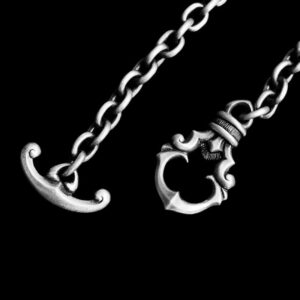
The 4mm Crescent and Shield Toggle Chain and the 8mm Heavy Hammered Cuban Chain Necklace provide two current catalog-defined outlines. Their listings identify different nominal diameters, which supports a narrow-versus-broad visual comparison. Those numbers do not prove comfort, performance, ideal proportion, or compatibility with every neckline. For measurement terminology, the NIST SI length reference provides a neutral unit boundary.
Role three: define the wrist outline
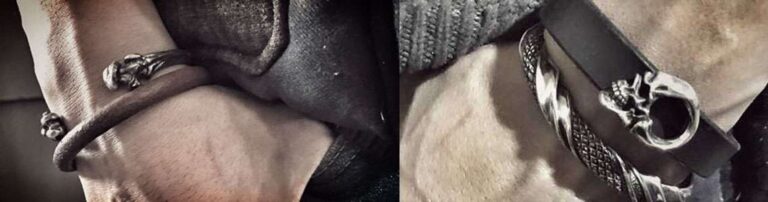
A wrist piece changes the area between hand, sleeve, and watch. A chain bracelet creates a linked line, while a cuff presents a more continuous form. Neither format is inherently more formal, more masculine, more durable, or easier to wear. The visible choice is whether you want movement and repeated links or a more unified outline.
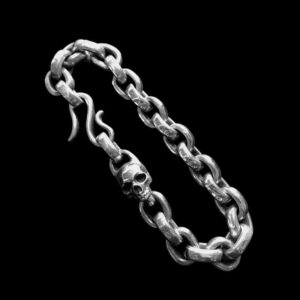
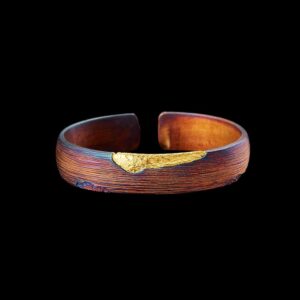
The Skull Clasp Chain Bracelet and Eagle Claw Red Stone Cuff Bracelet are current examples of those two formats. Their product records support their listed names and item-specific dimensions only. They do not prove fit, closure security, comfort, quality, durability, or safe use. Route measurement and fit questions to the men’s bracelet size guide.
If you also wear a watch, compare the outline rather than assuming both pieces must match. A bracelet can repeat one visible cue from the watch, such as a dark accent or geometric edge, while remaining different in texture. Alternatively, the watch can own the wrist and the bracelet role can be skipped entirely.
Role four: reserve one focal piece
A focal piece is the element you want the eye to notice first. It may be a sculptural ring, a broad chain, a detailed cuff, or a pendant. The category is less important than the concentration of contrast and detail. Once the focal point is selected, supporting pieces can become simpler, smaller in visible area, or farther away on the body.
This approach avoids a common collection problem: every purchase is individually dramatic, but the pieces have no clear hierarchy when worn together. A focal piece does not need to be the physically largest item. Strong color contrast, a recognizable face, a polished plane, or a dense silhouette can also lead the composition.
Role five: add a garment-specific accent only when needed
A garment-specific accent solves a repeated situation. Examples include an option that sits clearly inside an open collar, a wrist outline that remains visible beside a frequently worn cuff, or a quieter ring that works when a jacket already contains prominent hardware. This role should come after the core roles because it depends on clothes you actually wear.
Review photographs of your own outfits rather than building around a hypothetical event. If the same visual gap appears several times, a dedicated accent may be useful. If the gap appears only once, your existing anchor or focal piece may already be enough.
A practical three-piece starting point
A compact starting collection can cover three positions: hand, neckline, and wrist. Choose one as the anchor, one as the supporting line, and one as an optional focal point. The assignments can rotate. A detailed ring can lead one outfit, while a broader chain can lead another and the ring becomes secondary.
- Select the body position you already notice most in your outfits.
- Choose one piece for that position based on observable shape and prominence.
- Add a second piece at another position with lower visual competition.
- Add a third category only if it creates a distinct role rather than repeating the first two.
- Photograph the combination at normal viewing distance and remove one piece if the hierarchy is unclear.
The broader men’s jewelry styling guide can help with full-outfit coordination. This page remains focused on collection roles rather than trying to own every styling decision.
Use product examples without turning them into universal recommendations
Current catalog examples can make visual differences concrete, but they remain commercial examples. Availability may change, and item-specific labels do not establish demand, popularity, quality, comfort, durability, or a complete collection. The role should remain understandable even if a particular example is no longer available.
| Current example | Observable format | Possible collection role | What the listing does not prove |
|---|---|---|---|
| Handlebar Mustache Skull Ring | Concentrated face ring | Hand-worn anchor or focal piece | Popularity, fit, comfort, meaning, or universal suitability |
| Skull Clasp Chain Bracelet | Linked wrist outline | Wrist option | Closure performance, comfort, durability, or ideal sizing |
| Eagle Claw Red Stone Cuff Bracelet | Cuff with a contrasting accent | Wrist focal point | Fit, quality, symbolism, or safe-wear conditions |
| 4mm Crescent and Shield Toggle Chain | Narrower neckline line | Supporting neckline option | Ideal length, comfort, strength, or garment compatibility |
| 8mm Heavy Hammered Cuban Chain Necklace | Broader neckline line | Neckline focal point | Performance, popularity, status, or universal proportion |
Check for overlap before adding another piece
Two pieces overlap when they occupy the same position, create similar prominence, and answer the same outfit situation. Overlap is not automatically wasteful; some people enjoy variations of one format. It simply means the next purchase expands variety within a role rather than expanding the number of roles the collection can cover.
Before adding an item, compare it with what you own:
- Does it occupy a new body position?
- Does it introduce a clearly different outline or level of detail?
- Does it answer a repeated collar, cuff, or outfit situation?
- Can you name which existing piece becomes secondary when this one leads?
- Would you still choose it if no trend label or social claim were attached?
Separate style scope from technical scope
This role framework cannot determine fit, comfort, material identity, care, durability, physical-work suitability, or safe wear. Those questions require their own evidence and, where appropriate, specialist review. A source can show that rings, chains, bracelets, and pendants are discussed as men’s jewelry categories without proving that any MENSSKULL item is popular, complete, superior, or right for a particular person. For example, a dated Robbins Brothers men’s-jewelry overview supplies category-breadth context only.
Neither that external context nor the product records prove that one category, piece, collection, or arrangement is universally essential, better, safer, more comfortable, more durable, more attractive, more meaningful, or more appropriate. Technical decisions should be routed to their established owners instead of being inferred from style.
Final collection audit
Lay out the pieces you own and label each by its most frequent role. If several items share the same label, decide whether that repetition is intentional. If a role is empty, check whether your wardrobe actually needs it before shopping. A collection is practical when its pieces support real outfits and clear visual choices, not when it reaches a fixed count.
Start with one anchor, one contrasting position, and one optional focal point. Add only when a repeated outfit situation reveals a distinct job. That keeps the collection flexible while leaving fit, material, care, safety, and performance questions with the pages built to answer them.

MENSSKULL Journal Notes
Leave a field note
Share fit notes, styling ideas, care questions, or your experience with MENSSKULL silver jewelry.
Comments are checked before publication so buyers can read useful fit, symbolism, care, and style notes without spam noise.
The simple plus/minus challenge below helps block automated spam while keeping the experience lightweight.
Continue exploring
More MENSSKULL stories
Handcrafted silver
Shop the pieces behind the stories