

The useful way to choose men’s Christmas jewelry is to start with the role it should play. Look at what the recipient already wears, picture the actual holiday setting, decide how visible the piece should be, and check whether the same visual role still makes sense after the decorations come down. That sequence is more reliable than guessing from a festive motif or a broad label such as “statement” or “classic.”
Why Start With a Jewelry Role?
Christmas creates several different dressing situations in a short period: travel, a family lunch, an office gathering, a formal dinner, a casual visit, and New Year’s plans. A piece that looks appropriate in one setting can feel visually dominant in another. “Christmas jewelry” therefore describes a context, not one required design. The decision becomes easier when you define what the piece should do in that context.
A role can be subtle: a small accent that appears when a sleeve moves or when an open collar frames a pendant. It can be connective: a piece that repeats the dark, silver-tone, polished, or textured details already present in the outfit. It can also be focal: one clearly visible ring, bracelet, or pendant that carries most of the accessory attention. None of these roles is automatically better. The right role is the one that matches the recipient’s existing habits and the event’s visual level.
This page stays Christmas-specific. If the unresolved question is whether a ring, bracelet, or pendant is the better gift type in general, use the separate men’s jewelry gift-type guide. That owner covers the broader category decision; the guide here focuses on holiday setting, visual prominence, and likely use after the holiday.
Read the Recipient’s Existing Jewelry Habits
The strongest evidence is already visible. Review ordinary photographs or recall recent outfits. Does he regularly wear something on a finger, wrist, or at the neckline? Does one piece stay on while the rest of the outfit changes? Does he use accessories only for evenings, or are they part of everyday dress? These observations do not prove what he will like, but they reduce the number of unsupported assumptions.
Pay attention to placement before design language. A person who repeatedly wears rings has already made finger jewelry part of his visual routine. Someone who keeps the neckline empty but often wears a bracelet offers a different cue. If no jewelry is visible across several normal settings, a highly prominent piece asks for a larger style change. That does not make the choice wrong; it means the gift is less predictable and should be treated as an invitation rather than an expectation.
Use these cues as a record, not a personality test. A dark finish does not prove a dark personality; a skull does not prove a universal identity; and a minimal piece does not prove that the wearer dislikes detail. Observable choices describe past styling behavior only.
Match the Holiday Setting Before the Design
A family dinner usually places people close together in seated conversation. Jewelry can be noticed at the hand, wrist, or neckline without needing to dominate the whole outfit. An office celebration may include workwear details, mixed lighting, and a wider range of dress levels. A night event may support stronger contrast because the outfit itself is more deliberate. Define the setting first so “festive” does not become shorthand for “more decoration.”
Ask three concrete questions. How formal is the clothing likely to be? How many other visible details are already present? At what distance will the jewelry usually be seen? A ring can become a close-range accent during dinner. A pendant can form a clear center line with an open collar. A bracelet can appear intermittently beside a cuff. These are placement observations, not promises about comfort, suitability, or reaction.
| Holiday setting | Useful visual role | Observable cues to compare | What to avoid assuming |
|---|---|---|---|
| Family dinner | Quiet close-range accent | Familiar placement, moderate outline, limited contrast with shirt or knitwear | That a holiday motif will be welcomed |
| Office gathering | Controlled detail within workwear | One repeated metal-tone detail, clean silhouette, no competition with tie, watch, or patterned shirt | That a bolder piece is automatically more festive |
| Evening party | One deliberate focal point | Clear outline, stronger light-dark contrast, enough open space around the piece | That several focal pieces create a better result |
| Holiday travel | Familiar, easy-to-coordinate visual role | Works with more than one packed outfit and resembles an already-worn placement | Any performance, security, or wearability outcome |
| New Year’s plans | Sharper version of an existing style | More polished surface contrast or a more visible silhouette without changing every accessory | That event dressing predicts year-round use |
Choose the Level of Visual Prominence
Prominence is not the same as size. A small piece with strong contrast, a bright edge, or a detailed face can attract more attention than a larger shape that closely matches the clothing around it. Think about four variables together: outline, surface detail, contrast, and empty space. A clear outline separates a piece from the outfit. Dense surface detail rewards close viewing. Contrast increases noticeability. Empty space around the piece prevents nearby elements from competing with it.
For a restrained result, reduce at least two of those variables. Use a familiar outline, lower contrast, or fewer neighboring details. For a focal result, increase one variable clearly and keep the others controlled. A prominent pendant paired with a highly patterned shirt and several visible wrist details may have no clear hierarchy. A single strong ring beside otherwise simple accessories gives the eye a more obvious destination.
Use Outfit Detail Density as a Guardrail
Holiday clothing often introduces texture: knitwear, patterned shirts, jacket hardware, decorated collars, bright buttons, or layered fabrics. Jewelry enters an outfit that may already contain several small points of contrast. Count those visible points before adding another one. This simple check prevents a gift from being selected in isolation from the clothes that will frame it.
Low-detail outfits leave more room for an intricate or high-contrast piece. Medium-detail outfits usually benefit from one main jewelry role and a supporting detail. High-detail outfits call for restraint or stronger separation, such as placing one clear piece in an otherwise open area. The goal is not to enforce a formula. It is to decide whether the jewelry will read as a focal point, an echo, or visual noise.
If the recipient already wears gothic forms, browse the gothic jewelry category as a catalog of observable outlines and contrast levels. Treat it as commercial navigation, not evidence of identity, symbolism, popularity, or recipient preference.
Ring, Bracelet, or Pendant in a Christmas Outfit
Each placement interacts with holiday clothing differently. A ring stays visible during greetings, dining, and photographs that include the hands. A bracelet shares space with cuffs and watches. A pendant depends on the neckline, layers, and whether the center of the outfit is open or covered. Compare the placement to the planned clothing rather than choosing from an isolated product image.
Ring as a close-range accent
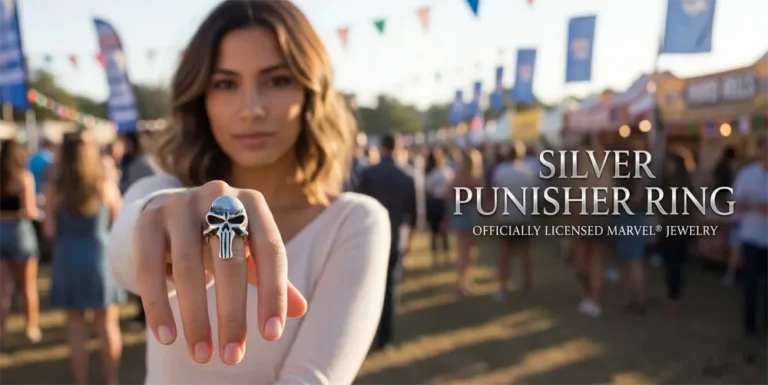
A ring can carry a clear silhouette without occupying the center of the outfit. Compare face coverage, edge shape, relief density, and contrast from the top and side views. For current visual examples, the skull ring category can show different face shapes and detail levels. The category does not determine sizing, wear experience, or whether a motif is appropriate for a recipient.
Bracelet as a moving wrist detail
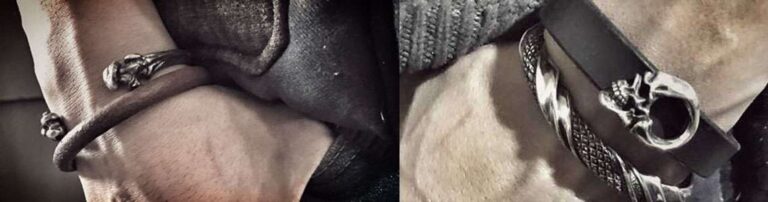
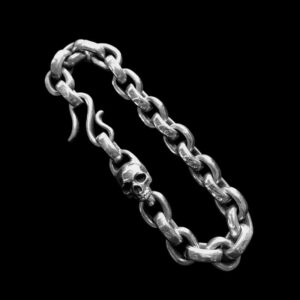
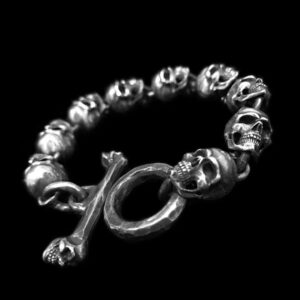
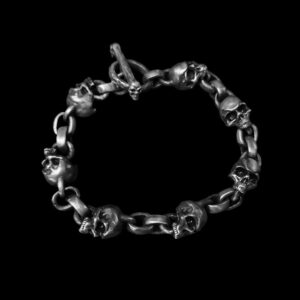
A bracelet appears and disappears with sleeve movement. Compare link scale, outline rhythm, and contrast against the expected cuff. If a watch is already part of the outfit, decide which wrist detail is intended to lead. The men’s silver bracelet category is useful for comparing observable forms, but not for inferring any fit or performance result.
Pendant as a center-line focal point
A pendant is visually tied to the neckline. Compare whether the shirt or knitwear creates enough open space for the outline to read. A dense pendant over a dense pattern may disappear; a simple outline against a plain field may become the strongest accessory. Use the silver pendant category to compare visible shapes only. Do not infer meaning or compatibility from imagery.
Plan for the Week After Christmas
A useful year-round check is to remove every holiday cue from the imagined outfit. Replace the festive dinner with a normal weekend, a routine evening, or an ordinary workday. Does the same placement still appear in the recipient’s wardrobe? Does the visual weight still match the clothes he already wears? Can the piece move from the holiday outfit into at least two ordinary outfit types without requiring a completely new accessory system?
This is not a prediction that the recipient will wear the gift. It is a compatibility exercise based on observed styling patterns. A Christmas-only visual can still be the intended choice when the recipient actively wants one. The point is to make that limitation explicit rather than accidentally selecting a seasonal novelty while expecting everyday use.
| Observation | Lower-assumption route | More experimental route | Decision note |
|---|---|---|---|
| Same placement appears often | Keep placement and similar visual weight | Increase detail or contrast slightly | Past use supports the placement, not the exact design |
| Jewelry appears only at events | Choose an event-scale accent | Choose a more visible focal piece | Do not label either option “daily” without evidence |
| No recurring jewelry is visible | Let the recipient choose or use a restrained form | Offer the piece as a deliberate new direction | Acknowledge the larger preference uncertainty |
| Outfits are usually low-detail | Use a clean outline with moderate contrast | Allow one intricate surface | Keep neighboring accessories quiet |
| Outfits are usually high-detail | Repeat one existing visual cue | Create one separated focal point | Avoid several equal-strength accents |
Build a Three-Outfit Test
Before deciding, picture the piece in three outfits rather than one. The first is the planned Christmas setting. The second is a normal cold-weather outfit in January. The third is an ordinary outfit from another season. You are not trying to prove future use. You are checking whether the visual role survives when the surrounding context changes.
- Holiday outfit: identify the main clothing texture, the number of visible accessories, and the intended focal area.
- January outfit: remove festive colors and event-specific details; keep only the recipient’s normal layers.
- Everyday outfit: compare the piece with a familiar shirt, jacket, or T-shirt combination.
- Decision: note whether the piece remains an accent, becomes a focal point, disappears, or competes with other details.
If the role changes dramatically in every outfit, the choice may be strongly event-specific. If the role stays coherent across two or three, it has a clearer visual path beyond Christmas. Again, this supports a styling decision, not a promise of use.
Separate Seasonal Demand From Product Claims
Current publishing activity shows that jewelry is actively included in the 2026 Christmas gift conversation. Woman & Home published a fashion Christmas gift guide on October 14 that includes jewelry among fashion gifts. Luxury London published a men’s watch and jewelry Christmas guide on September 25. CRAFTD published a men’s Christmas jewelry gift guide on September 29.
Common Christmas Jewelry Decision Errors
Starting with a universal symbol
A motif may have many historical, cultural, commercial, or personal readings. Do not choose it by assuming one meaning applies to everyone. Use a motif only when the recipient has already shown interest or can confirm the interpretation.
Equating “festive” with more detail
More detail can reduce clarity when the outfit is already busy. Festive context can come from a sharper version of an existing style, one deliberate focal point, or a repeated visual cue. It does not require a Christmas symbol.
Designing for the photograph instead of the person
A product photograph isolates the piece. Real outfits add sleeves, collars, patterns, watches, eyewear, hardware, and movement. Compare the jewelry against those surrounding elements before judging prominence.
Treating category navigation as evidence
Categories show available forms. They do not establish preference, size, meaning, or a gifting outcome. Use them to compare visible shapes and then return to the recipient’s observed habits.
A Low-Assumption Christmas Decision Path
Use the following path when the gift must remain a surprise:
- Record the placement he already wears most often.
- Describe the holiday setting in one sentence.
- Count the outfit’s other visible details.
- Choose a quiet accent, supporting detail, or focal role.
- Run the three-outfit test for Christmas, January, and an ordinary day.
- Remove any choice that depends on an unverified personal meaning.
- If uncertainty remains high, let the recipient select the exact piece.
This route deliberately avoids pretending that a visual match answers every buying question. It narrows the styling role while leaving all product-specific facts to the exact listing and selected option.
What This Guide Does Not Verify
This article cannot promise sizing, fit, comfort, safety, material quality, care results, durability, scratch resistance, engraving performance, symbolism, legal suitability, price, value, commitment meaning, social approval, or relationship outcomes. It also cannot predict recipient approval or future wear. Verify every product-specific fact, available option, order condition, and return term on the exact product page before checkout.
Christmas Jewelry Checklist
- The choice is based on an observed placement or an explicit request.
- The holiday setting is defined before the design is selected.
- The piece has one clear role: quiet accent, supporting detail, or focal point.
- The outfit’s existing detail density has been considered.
- The design still has a coherent visual role in at least one non-holiday outfit.
- No meaning, personality, status, popularity, or gift reaction has been inferred.
- Any category link is being used for navigation, not proof.
- The exact listing will be checked for all transactional and product-specific details.
Final Decision
Men’s Christmas jewelry works best as a defined styling role rather than a bundle of assumptions. Start with what he already wears, match the piece to the real holiday setting, control visual prominence, and test the same role outside December. A subtle family-dinner accent, a single party focal point, and a year-round supporting piece are three different decisions. Naming the role makes the choice clearer and keeps the surprise grounded in visible evidence.
When two options remain, compare them in the same imagined outfit rather than switching the surrounding clothes to favor each piece. Hold the setting, shirt, outer layer, and other accessories constant. Then compare placement, outline, contrast, and nearby detail. The cleaner visual role is usually the easier decision to explain. If neither option connects to an observed habit, that uncertainty is useful information: pause the surprise, ask a narrow preference question, or make the final selection collaborative. A clear limitation is more honest than a confident guess.


MENSSKULL Journal Notes
Leave a field note
Share fit notes, styling ideas, care questions, or your experience with MENSSKULL silver jewelry.
Comments are checked before publication so buyers can read useful fit, symbolism, care, and style notes without spam noise.
The simple plus/minus challenge below helps block automated spam while keeping the experience lightweight.
Continue exploring
More MENSSKULL stories
Handcrafted silver
Shop the pieces behind the stories