
Silver jewelry can make a man’s outfit look more deliberate, but it cannot guarantee attractiveness. Attraction is subjective and depends on the observer, the wearer, the setting, and the complete presentation. A better buying question is whether a ring, chain, or bracelet has the right scale, finish, fit, and visual role for the clothes and other accessories around it.
Does Silver Jewelry Make Men More Attractive?
There is no universal answer. Silver can create a clear highlight against dark clothing, repeat the cool tone of watch hardware, or make a simple outfit feel more finished. The same piece can also look distracting when it is poorly fitted, out of proportion, or competing with too many other details. That is why “more attractive” is too broad to use as a product promise.
Use four practical questions instead:
- Does the piece have a clear role in the outfit?
- Is its scale balanced with the wearer’s hand, wrist, neckline, and clothing?
- Does the finish create the amount of contrast the wearer wants?
- Can the exact size, length, closure, material description, and construction be verified before ordering?
This approach keeps style personal while making the purchase decision more specific.
Use a Style Framework, Not an Attraction Claim
| Decision | What to inspect | Useful question |
|---|---|---|
| Visual role | Focal piece, supporting detail, or repeated metal accent | What should the eye notice first? |
| Scale | Width, face dimensions, chain diameter, bracelet width, and overall silhouette | Does the piece suit the available visual space? |
| Finish | Polished, brushed, oxidized, textured, or mixed surfaces | Should it reflect light or read more quietly? |
| Fit | Ring size, chain length, bracelet circumference, closure, and movement | Are the selectable measurements appropriate for the wearer? |
| Restraint | Number of motifs, metal finishes, and competing focal points | Can one element lead while the others support it? |
The broader men’s jewelry styling guide covers coordination across accessory types. This page focuses more narrowly on evaluating silver as part of a complete look without turning preference into a promise.
Choose the Visual Role First
A piece is easier to style when its job is clear. A sculptural ring can be the focal point while a chain stays visually quiet. A substantial bracelet can lead at the wrist while rings repeat only the metal color. A decorative necklace closure can become the main detail when it is visible near the neckline.
Problems usually appear when every item tries to lead. A large ring, ornate chain, heavy bracelet, patterned watch, bright buckle, and detailed jacket hardware can divide attention into too many small contests. Removing one or two competing elements often improves the hierarchy more than buying another accessory.
Before shopping, decide whether the new piece should be dominant, supportive, or nearly neutral. That single choice narrows the useful scale, motif, and finish.
Match Scale to the Space Around the Jewelry
Scale is not the same as quality. It describes how much visual area a piece occupies and how strongly it reads from normal viewing distance. A wide ring face occupies more of the hand than a narrow band. A 10 mm bracelet creates a different wrist line from a fine chain. A long necklace changes the vertical balance of a shirt or jacket differently from a short chain near the collar.
Written measurements are more useful than a tightly cropped product photograph. Compare ring face dimensions with neighboring fingers, chain length with the intended neckline, and bracelet sizing with the seller’s definition of the selectable option. Use the men’s ring size and fit Research guide, the men’s necklace length guide, and the men’s bracelet size guide for those separate measurement decisions.
Do not infer comfort, durability, or real-world weight from appearance alone. Verify the exact listing and selected variation.
Use Finish to Control Contrast
Polished high points return more light and can create a sharper highlight against dark fabric. Brushed or textured areas usually read more quietly. Oxidized recesses can make carved details easier to distinguish by increasing light-dark separation. Mixed finishes can create hierarchy within one object.
These are visual observations, not quality rankings. A highly polished surface is not automatically better made, and dark recesses do not prove age, hand production, or metal fineness. The sterling silver jewelry quality Research guide explains why material description, construction, finish, and seller evidence should be evaluated separately.
Judge finish in the lighting where the jewelry will actually be worn. Studio photography may intensify reflections and shadows. When possible, compare front, side, and rear views rather than relying on one dramatic image.
Compare Ring, Chain, and Bracelet Proportions
The following examples illustrate three different style roles. Specifications were checked from the live MENSSKULL listings on September 20, 2026. They are mutable commercial details, so the current product page and selected option remain the final source before ordering.
| Example | Current listed scale | Possible visual role | Verify before ordering |
|---|---|---|---|
| Handlebar Mustache Skull Ring | 33 × 20 mm face reference; 23 g listed weight | Sculptural hand-level focal point | Selectable ring size, dimensions, material statement, and current imagery |
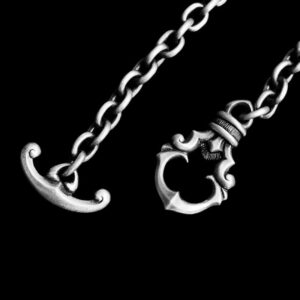
| Crescent and Shield Toggle Chain | 4 mm diameter reference; selectable 45–70 cm lengths | Linear neckline accent with a decorative closure | Selected length, closure operation, listed weight basis, and included components |
| Skull Clasp Chain Bracelet | 10 mm width reference; selectable wrist-circumference labels | Substantial wrist-level focal point | Meaning of the size option, closure, listed weight range, and material statement |
The examples are not ranked and do not prove an outcome. They show why accessory type and scale should be chosen before deciding whether a piece looks right for one wearer. A buyer who wants a quieter result can browse the broader men’s silver rings collection and compare dimensions rather than assuming every silver ring has the same visual intensity.
Fit and Placement Affect the Whole Impression
A piece that shifts, twists, hangs at an unintended point, or competes with a cuff may look unresolved even when its design is strong. Fit is therefore part of presentation, but it should not be reduced to a universal rule.
For rings, measure the intended finger and consider the width and shape of the band. For chains, compare the selected length with the neckline and pendant plan. For bracelets, identify whether the option describes wrist circumference, finished bracelet length, or another measurement. Those definitions are not interchangeable.
Placement also changes with clothing. A chain visible over a plain shirt has a different role from one partly hidden beneath a collar or hoodie. The chain-over-or-under-hoodie guide shows how visibility, movement, and layering can change the styling decision without claiming one placement is always correct.
Coordinate Silver With Clothing and Hardware
Silver often works as a cool-toned highlight against black, charcoal, navy, denim, leather, and plain knitwear, but no color pairing is mandatory. The relevant question is contrast. A bright polished piece may stand out strongly on matte black fabric, while an oxidized or brushed surface can feel more integrated with textured clothing.
Look at nearby hardware: watch cases, belt buckles, jacket zippers, eyewear, bag fittings, and shoe details. Exact matching is unnecessary. Repeating a cool metal tone once or twice can create continuity, while deliberate mixed metals can also work when one finish remains dominant.
View the complete outfit from several feet away. Product close-ups are designed to reveal detail; normal viewing distance shows whether the jewelry supports the silhouette or fragments it.
Practice Restraint Without Erasing Personality
Restraint does not mean every piece must be small or minimal. It means the visual hierarchy is understandable. One large skull ring can be more controlled than five unrelated small motifs. A substantial bracelet can look deliberate when the watch and rings are quieter. An ornate chain can lead when the shirt and outerwear provide clean space around it.
A useful editing method is to assemble the complete combination, then remove one item. If the remaining pieces read more clearly, the removed item was competing rather than supporting. If the outfit loses structure, restore it. This is a reversible styling test, not a rule about masculinity, confidence, or social status.
Verify the Silver Claim Separately From Style
Color and attractiveness do not establish metal composition. A seller’s 925 or sterling-silver description is a material representation that should be evaluated independently from design preference. The 925 sterling silver Research guide explains fineness terminology and evidence boundaries. The U.S. Federal Trade Commission also provides consumer guidance for buying silver jewelry, while 16 CFR Part 23 contains U.S. rules for precious-metal representations.
A stamp, photograph, finish, or product story should not be stretched into proof of every component, production method, origin, or quality outcome. When a listing relies heavily on handmade, forged, cast, artisan, or workshop language, use the silver jewelry manufacturing claims guide to separate process wording from evidence about the finished item.
Keep Care Separate From Attraction
Surface appearance changes with wear, storage, contact, and cleaning. That does not create a universal schedule or make one finish more attractive to everyone. Follow instructions appropriate to the complete piece, especially when it includes intentional oxidation, stones, coatings, adhesive, leather, or mixed materials.
For finish-specific boundaries, use the sterling silver jewelry care Research guide. Care is maintenance guidance, not evidence that a product will remain scratch-free, resist every chemical, or look identical over time.
A Practical Buying Checklist
- Choose whether the piece will lead, support, or quietly repeat another metal detail.
- Compare written dimensions and selectable measurements, not only photographs.
- Decide how much reflection, texture, and dark contrast you want.
- Check how the piece interacts with clothing, watch hardware, and other jewelry.
- Verify the exact material statement, components, construction, closure, and option selected.
- Use product examples as design references, not proof of attractiveness, confidence, status, or popularity.
- Read the current product page, care guidance, and return terms before ordering.
Frequently Asked Questions
Does silver jewelry make every man more attractive?
No. Attractiveness is subjective. Silver jewelry can create contrast, repetition, and a more deliberate accessory hierarchy, but it cannot guarantee how another person will respond.
What makes men’s silver jewelry look intentional?
A clear focal point, proportionate scale, verified fit, coordinated finish, and restraint usually make the styling logic easier to read. The exact combination remains personal.
Should a man wear a ring, chain, or bracelet first?
Choose the area you want to emphasize. A ring leads at the hand, a bracelet at the wrist, and a chain at the neckline or chest. Start with one role, then add supporting pieces only if the hierarchy stays clear.
Is polished silver more attractive than oxidized silver?
Not universally. Polished surfaces return more light, while oxidized recesses can increase contrast around detail. The preferred appearance depends on the design, lighting, clothing, and wearer.
Does a 925 stamp prove that a piece is high quality?
No. A 925 mark is a fineness claim. It does not by itself prove construction, finish quality, every component, origin, durability, or workmanship.
How many silver pieces should a man wear at once?
There is no mandatory number. Use one clear focal point and add other pieces only when they support rather than compete with it.





MENSSKULL Journal Notes
Leave a field note
Share fit notes, styling ideas, care questions, or your experience with MENSSKULL silver jewelry.
Comments are checked before publication so buyers can read useful fit, symbolism, care, and style notes without spam noise.
The simple plus/minus challenge below helps block automated spam while keeping the experience lightweight.
Continue exploring
More MENSSKULL stories
Handcrafted silver
Shop the pieces behind the stories