
Men can wear bracelets on both wrists. The clearest result usually comes from treating the two sides as a composition rather than making them identical. Give one wrist the stronger piece or fuller stack, then let the other wrist play a quieter supporting role. That small difference creates balance without turning both forearms into competing focal points.
This is a visual styling guide, not a rule about gender, status or what jewelry is permitted. The useful question is how scale, spacing, a watch and the rest of the outfit affect the overall picture. Start with pieces you already own, compare one wrist with both wrists, and judge the result from normal conversation distance before buying anything new.
Can men wear bracelets on both wrists?
Yes. Wearing bracelets on both wrists can look deliberate when the left and right sides share one idea but do not repeat each other exactly. A pair of equally bold stacks can divide attention. A stronger side and a quieter side give the eye an obvious place to begin, while still making the second bracelet feel connected.
There is no required wrist. Your dominant hand, watch placement and daily habits can influence what feels natural, but none of them creates a universal style law. If your real question is whether a bracelet should share space with a watch, use the separate bracelet-and-watch same-wrist guide. This page focuses on distributing bracelets across both wrists.
Use asymmetry as the starting point
Asymmetry does not mean the two wrists should look unrelated. It means they should carry different amounts of visual weight. One side might hold a wider chain bracelet, while the other carries a narrower link or a single cuff. The shared metal tone, finish or design language connects them; the difference in scale keeps the arrangement from looking like a matched uniform.
A simple starting formula is 60/40 rather than 50/50. Choose a lead wrist and place the more noticeable piece there. On the other side, reduce width, detail or quantity. You do not need to measure that ratio. It is only a quick way to remember that balanced styling can be unequal.
| Two-wrist setup | Visual effect | First adjustment |
|---|---|---|
| One bold bracelet plus one slim bracelet | Clear lead side with a quiet echo | Keep one shared detail, such as metal tone or finish |
| One bracelet on each wrist at similar width | More symmetrical and graphic | Vary texture or outline so the pair is not a mirror image |
| Small stack on one wrist plus one bracelet on the other | Layered but still directional | Let the single bracelet remain visibly simpler |
| Watch on one wrist plus bracelet on the other | Separated focal points | Compare their apparent scale from several steps away |
Choose the lead wrist before adding a second bracelet
Build the stronger side first. Put on the bracelet or small stack that matters most, straighten your sleeves and look at the whole upper body. Then add one piece to the other wrist. If your attention jumps back and forth without settling, the supporting bracelet may be too wide, too bright or too detailed.
The lead wrist does not need to be the dominant hand. It can be the side without a watch, the side shown more clearly by a rolled sleeve, or simply the side that makes the outfit feel more settled. If you also wear rings, the ring-and-bracelet same-hand guide explains how those two focal points can share one side. Use that decision first, then decide whether the opposite wrist still needs a bracelet.
Balance a watch without copying it
A watch already has a case, dial and strap that create a defined block on the wrist. A bracelet on the opposite side does not need to match every detail. Instead, compare apparent weight. A substantial watch can be balanced by one medium-scale bracelet; a slim watch may look more coherent opposite a quieter chain or cuff.
Matching every finish can make the outfit feel overly calculated. Repeating just one characteristic is often enough: a cool metal family, a dark accent, a clean outline or a similarly restrained level of detail. For the wider outfit, the watch, jewelry and belt-buckle coordination guide covers how much matching is useful without requiring identical accessories.
Compare width and visual weight, not just bracelet count
Two bracelets can look more dominant than four if those two are wide, bright and highly detailed. Count is therefore a weak shortcut. Look instead at width, link size, surface contrast and how much wrist space each side occupies. A single heavy-looking outline can lead the composition even when the opposite side has two narrow pieces.
If you are comparing chain styles and proportions, the men’s silver bracelet guide provides a broader overview of link scale and bracelet forms. Use live product listings only for the exact dimensions and options of a particular item. A category or guide can help with visual direction, but it does not prove that one width is universally right for every wrist.
Repeat one element across both wrists
Two-wrist styling becomes easier when the pieces share one visible connection. That connection might be color, finish, link geometry or theme. The pieces do not have to be a set. In fact, a subtle relationship usually looks more personal than a perfectly matched pair.
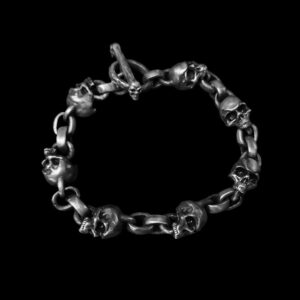
For example, a darkened silver chain on one side can connect with a simpler silver cuff on the other through color while differing in structure. Two chain bracelets can share metal tone while using different link sizes. A motif-led bracelet can be balanced by a plain piece that repeats only its general finish. If you are working with a specific cross motif, the men’s cross bracelet guide keeps that motif decision separate from the two-wrist layout.
Avoid making both sides equally busy
When both wrists have several high-contrast pieces, the outfit can lose a clear hierarchy. The issue is not that a maximal look is forbidden. It is that maximal styling needs an intentional rhythm. If every bracelet has a different width, finish, motif and color, the viewer has no obvious way to read the arrangement.
Reduce one variable at a time. First remove one piece from the quieter wrist. If the result still feels crowded, simplify the finish or narrow the scale on that side. Do not rebuild both stacks at once, because you will not know which change improved the balance.
| What you notice | Likely visual cause | Adjustment to test |
|---|---|---|
| Both wrists compete for attention | Similar width, shine and detail on each side | Quiet one wrist by reducing width or quantity |
| The second bracelet looks unrelated | No repeated color, finish or design line | Repeat one visible element without making a matched pair |
| One wrist looks empty beside the other | The difference in scale is too large for the outfit | Add one quiet piece or reduce the lead stack |
| The outfit feels accessory-heavy | Wrists, rings, necklace and clothing all have equal emphasis | Choose one primary jewelry zone and simplify the others |
| The arrangement looks too symmetrical | Pieces mirror each other in position and scale | Shift width, texture or sleeve exposure on one side |
Let sleeves change the final decision
Short sleeves expose both wrists at the same time, so differences between the two sides are easy to see. Long sleeves create a different frame. One cuff may reveal more bracelet than the other, especially while moving, sitting or using a phone. Judge the bracelets with the sleeves in their normal position rather than arranging them only for a mirror photo.
With a dress shirt or structured overshirt, a bracelet can sit visually near the cuff edge. The bracelet and shirt-cuff guide explains that specific placement choice. When bracelets are on both wrists, use the same general logic but allow one cuff to reveal less. Unequal exposure can reinforce the intended lead-and-support relationship.
Coordinate both wrists with rings and necklaces
Bracelets do not exist in isolation. Rings add detail near the hands, while a necklace creates a focal point at the center of the outfit. If both wrists are active and several rings are visible, a bold necklace may turn three separate zones into equal competitors. Decide which zone should lead.
One practical sequence is necklace first, lead wrist second, supporting wrist third, rings last. Another is to make the wrists the main feature and keep the neckline quiet. The men’s jewelry styling guide gives a wider framework for scale and balance across rings, chains and bracelets.
Adapt the two-wrist look to the outfit
A plain T-shirt, knit or simple jacket gives two-wrist styling more visual space. Patterned shirts, contrast cuffs and graphic outerwear already carry several focal points, so the bracelet arrangement may need to become quieter. This is not a formal-versus-casual ban. It is a question of how many strong details are visible at once.
For workwear, compare a chain bracelet or cuff with the broader outfit using the workwear jewelry guide. For a date outfit, the men’s date-night jewelry guide offers a context-specific way to judge emphasis. In either case, bracelets on both wrists work best when they support the clothing rather than becoming two unrelated displays.
Use a three-view test before buying another piece
First, stand naturally with both arms at your sides. Check whether one wrist clearly leads or whether they appear equally loud. Second, bend your elbows as you would while talking or using a phone. This shows how the bracelets read during normal movement. Third, take a waist-up photo from several steps away. A close-up exaggerates small details and can make a balanced arrangement seem busier than it appears in real life.
Repeat the test with the watch, rings, sleeves and outer layer you expect to wear. If the supporting wrist disappears completely, it may not need more jewelry; quiet can be part of the balance. If the lead wrist overwhelms the outfit, remove one element before adding anything to the other side.
Buying checklist for a second-wrist bracelet
Use this sequence when the first wrist is already established:
- Choose which wrist should lead and which should support.
- Record the visible width and overall emphasis of the lead bracelet or stack.
- Look for one shared element such as finish, color or link geometry.
- Choose a supporting piece with less visual weight rather than an exact duplicate.
- Check the listed size against your own wrist measurement.
- Test the arrangement with your usual watch, rings and sleeve position.
- Review the live listing for the exact dimensions, options and current availability.
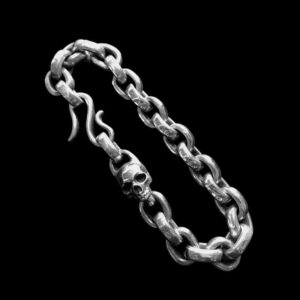
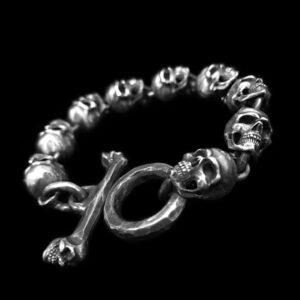
The men’s bracelet size guide covers measuring and fit as a separate decision. If you prefer a heavier focal piece, compare its scale through the heavy skull bracelet guide before deciding what the quieter wrist should carry.
Quick answer
Men can wear bracelets on both wrists. The most reliable approach is controlled asymmetry: let one wrist carry the stronger piece or fuller stack, keep the other simpler, and repeat one visible element across both sides. Judge width and visual weight rather than bracelet count, account for a watch and sleeve exposure, and test the complete outfit from normal distance. The goal is not perfect symmetry; it is a clear lead wrist, a supporting wrist and one coherent overall look.



MENSSKULL Journal Notes
Leave a field note
Share fit notes, styling ideas, care questions, or your experience with MENSSKULL silver jewelry.
Comments are checked before publication so buyers can read useful fit, symbolism, care, and style notes without spam noise.
The simple plus/minus challenge below helps block automated spam while keeping the experience lightweight.
Continue exploring
More MENSSKULL stories
Handcrafted silver
Shop the pieces behind the stories