
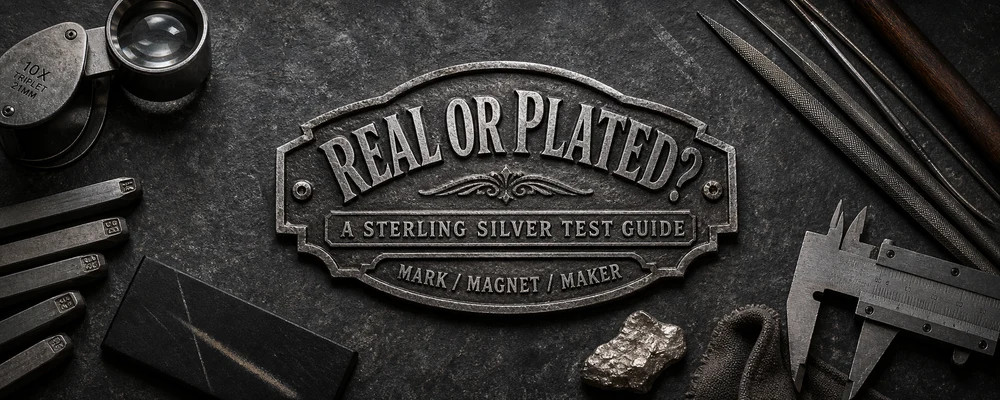
Answer first: the safest way to tell if sterling silver is real is to combine independent evidence rather than trust one household test. Start with the seller’s written metal description, inspect the fineness and responsibility marks under magnification, look for plating wear, and use a magnet only to screen for strongly magnetic components. If the answer affects a return, insurance value, resale price, or a sentimental piece, ask a qualified jeweler or precious-metal professional to test it. A 925 stamp, dark tarnish, a nonmagnetic result, or a successful ice trick can support a theory, but none proves by itself that the entire object is sterling silver.
That distinction matters because buyers often ask how to tell if sterling silver is real after a marketplace purchase, thrift-store find, inherited chain, or unexpected skin reaction. Online advice tends to reduce the problem to a dramatic yes-or-no trick. Real identification is closer to an evidence ladder: each clue answers a limited question, and the confidence rises only when the clues agree. This guide shows what every step can establish, what it cannot establish, and how to avoid damaging jewelry while you investigate.
Use the evidence-based 925 hallmark and testing guide when a stamp, magnet result or surface appearance is being treated as proof by itself.
When a listing leans on process language such as handmade, cast, forged, artisan-produced or workshop-made, use the silver jewelry manufacturing claims guide to separate a process description from evidence about metal fineness, origin or finished-product quality.
What “real sterling silver” actually means
In the United States, “sterling,” “sterling silver,” and similar unqualified descriptions are reserved for an alloy that is at least 925 parts silver per thousand. The Federal Trade Commission’s consumer guidance on precious-metal jewelry explains the 92.5 percent meaning and notes that silver plate is different: it is a silver layer applied over another metal. The governing FTC jewelry rule on silver-content representations also treats an unqualified silver claim differently from an accurately disclosed coating.
Therefore, “real silver” is not one precise shopping category. A piece may be solid sterling silver, a different silver fineness, silver-plated base metal, gold-plated sterling silver, a mixed-metal design, or a product that uses a silver-colored material without claiming precious-metal content. Your first task is not to prove that something looks silver. It is to identify the exact claim being tested.
Separate composition from appearance
A bright white surface can come from polished sterling, rhodium plating, silver plating, stainless steel, or another alloy. A dark surface can be intentional oxidation, natural tarnish, residue, or a dark base metal exposed through worn plating. Color alone does not report the percentage of silver below the surface.
Separate a fineness mark from a full hallmark
People often call every 925 stamp a hallmark, but the terms are not always interchangeable. A fineness mark communicates a claimed purity. A maker’s or responsibility mark identifies who stands behind that claim. A hallmark in a compulsory assay system can include evidence of independent testing. GIA’s discussion of precious-metal marks explains these distinct roles and notes the U.S. relationship between a fineness stamp and a registered maker or responsibility mark.
If you need a deeper mark-by-mark primer before continuing, read the MENSSKULL guide to the meaning of a 925 silver hallmark. The important point here is that a stamped number is evidence to inspect, not a laboratory result generated every time the stamp is applied.
Why no single home test proves sterling silver
A useful test must distinguish sterling from plausible alternatives. Many popular tricks fail that standard. Copper, brass, some stainless steels, and plated objects can share one or more behaviors with sterling. A clasp may contain a small spring made from a different metal. Soldered joints can differ from the main body. A hollow object may feel lighter than expected. A heavily oxidized finish may not behave like freshly polished silver at the surface.
This is why a nonmagnetic result cannot prove 925 composition, and a localized magnetic response cannot automatically condemn the entire piece. It is also why tarnish, smell, sound, thermal conductivity, and polishing-cloth residue should be treated as clues. Each observation narrows possibilities; none measures the bulk alloy on its own.
Think in confidence levels
- Low confidence: color, shine, sound, seller photos, or one household trick.
- Moderate confidence: coherent marks, credible seller documentation, consistent construction, and no conflicting wear evidence.
- Higher confidence: the moderate-confidence evidence plus professional testing suited to the object’s construction and value.
The correct confidence level also depends on the decision. You may need only moderate confidence before wearing an inexpensive piece. You should demand stronger evidence before paying a precious-metal premium, disputing a transaction, insuring an heirloom, or melting an object that may have historical value.
How to tell if sterling silver is real: the evidence ladder
Step 1: preserve the purchase evidence
Before cleaning, scratching, or testing anything, save the listing, receipt, invoice, packaging label, seller messages, and return deadline. Capture the exact material language. “Sterling silver,” “925 silver,” “silver plated,” “silver tone,” and “silver color” do not make the same claim. If a marketplace listing changes later, your saved record may be the clearest evidence of what you were promised.
Check whether the seller identifies the whole item or only one component. A pendant may be sterling while its included chain is stainless steel. A bracelet may combine sterling decorative parts with leather. Earrings may use a sterling front and a different post or backing. Do not extend a true claim about one component to every detachable part.
Step 2: examine marks with a loupe and good light
Search logical locations: inside a ring shank, beside a pendant bail, on a clasp tab, near an end cap, behind an earring, or on the reverse of a money clip. Record every mark, not just 925. Look for “STERLING,” “STER,” a millesimal number, a maker’s symbol, country or assay-office marks, and words that disclose plating or another metal.
Do not reject an item solely because a mark is small, worn, or absent. Tiny components may have limited stamping space; vintage and handmade objects can follow different marking practices; resizing or repair can disturb a mark. Conversely, a crisp 925 stamp is not conclusive because a stamp can be applied to metal that was never independently assayed. Compare the location and style of the marks with the construction rather than treating neatness as proof.
Step 3: inspect high-wear areas for another color
Under magnification, inspect edges, corners, clasp contact points, the inside lower half of a ring, the back of a pendant, and surfaces that rub against clothing. Worn plating may reveal yellow brass, reddish copper, gray steel, or another substrate. Flaking, blistering, or a sharp boundary between surface colors is more consistent with a coating than with one alloy throughout.
Be careful with two-tone and intentionally mixed-metal designs. A brass accent does not make a product fraudulent if the brass is visible and accurately disclosed. Gold-plated sterling can also show sterling beneath its gold-colored layer. Compare the physical evidence with the exact listing instead of assuming that every color transition is deception. The MENSSKULL comparison of sterling silver versus silver-plated jewelry explains the structural difference in more detail.
Step 4: use a magnet as an exclusion screen
Move a small, strong magnet slowly near separate areas without slamming it into the jewelry. Strong attraction from the main body conflicts with a claim that the body is sterling silver. Test clasps, springs, pins, posts, and decorative sections separately because findings can contain functional metal parts that respond differently.
No attraction does not prove sterling. Many non-silver metals are also nonmagnetic, and a silver-plated copper or brass object may pass this screen. A weak or localized response needs interpretation rather than an immediate verdict. For a fuller explanation, see whether sterling silver is magnetic and why clasp hardware can complicate the result.
Step 5: treat tarnish and polishing residue as supporting clues
Sterling silver can develop gray, brown, or black silver-sulfide tarnish. The Smithsonian Museum Conservation Institute describes silver tarnish as a sulfide layer influenced by environmental conditions in its conservation summary on silver surfaces. A soft silver-polishing cloth may remove dark residue from some tarnished areas.
However, tarnish does not certify composition. Silver plate can tarnish because its surface is silver, intentionally oxidized sterling may already be dark, and coatings can delay visible tarnish. Aggressive polishing can also remove patina, soften engraved details, or wear through plating. If you are unsure whether darkness is intentional, consult the guide to oxidized silver versus tarnish before rubbing the surface.
Step 6: compare construction, weight, and seller logic
Ask whether the price, stated weight, dimensions, and construction make sense together. A large solid-looking pendant at an implausibly low weight may be hollow, plated, resin-filled, or inaccurately described. A substantial chain offered at a price far below its claimed silver content deserves more scrutiny. Yet weight alone cannot identify an alloy because hollow construction, link geometry, stones, resin, leather, and mixed metals all change the total.
Use a scale only when you have a meaningful comparison, such as a published weight for the exact model and size. Do not compare unrelated designs by grams and conclude that the heavier one is more authentic. Purity and durability are also separate questions; the 925 versus 950 silver comparison explains why a higher fineness number does not by itself settle construction quality or suitability.
Step 7: escalate to professional testing when the decision matters
A jeweler, assay office, precious-metal buyer, or qualified testing service may use methods such as touchstone testing, chemical testing, or X-ray fluorescence. Every method has a scope and limitations. Surface-focused methods can be complicated by plating, solder, coatings, and heterogeneous construction, so tell the tester what you need to know: surface metal, bulk composition, individual components, or approximate fineness.
Ask whether the proposed method will leave a mark and whether multiple locations need examination. For a valuable, antique, signed, stone-set, hollow, or sentimental object, request the least destructive suitable method first. A professional opinion is especially important when the conclusion will support a refund dispute, appraisal, resale description, or repair decision.
How to read common silver marks without overclaiming
925, .925, S925, Sterling, and Ster
These markings generally represent a sterling claim, meaning 925 parts silver per thousand. Their presence supports the claim but does not independently verify that the whole object matches it. Look for a responsibility or maker’s mark and evaluate whether detachable components have separate identities.
800, 900, 950, 958, and 999
These numbers can denote other silver fineness standards in the right context. They are not all sterling. A 950 silver object contains a greater nominal silver proportion than 925, while 900 is often associated with coin silver terminology in U.S. consumer guidance. Country, date, maker, and hallmark system matter when interpreting unfamiliar marks.
EP, EPNS, silver plate, plated, and silver tone
These words point away from a solid-sterling claim. EPNS traditionally refers to electroplated nickel silver, where the silver is a surface layer and “nickel silver” is a base-metal alloy name rather than a silver-fineness statement. “Silver tone” usually describes appearance, not precious-metal content. Do not pay a sterling premium unless the seller makes and supports a sterling claim.
International hallmarks
Do not apply U.S. expectations blindly to imported or vintage jewelry. In the United Kingdom, for example, official guidance states that a complete compulsory hallmark uses multiple marks and that qualifying precious-metal articles are independently tested. The UK government’s hallmarking guidance summary also explains statutory weight exemptions, which is one reason the absence of a full UK hallmark does not answer every small-item question.
Adjust the inspection to the type of jewelry
Chains and bracelets
Inspect the clasp, end caps, jump rings, solder points, and several links away from the clasp. Sellers and counterfeiters can assemble components of different metals, while legitimate makers may use a functional spring that is not sterling. Test the main chain separately from the clasp and check whether the listing includes or excludes detachable hardware.
Rings
Look inside the shank, especially near previous sizing seams. Examine the lower outside band for plating wear and the shoulders for solder or attached decorative parts. Stone settings and accents can introduce different metals. Do not acid-test near stones, enamel, patina, or porous inlays.
Pendants and earrings
Check the pendant body, bail, jump ring, chain, earring post, and backing as separate components. A sterling pendant sold without a chain should not be judged by an unrelated chain added later. Earrings may use specialized post, hinge, or spring parts; document localized magnet results instead of assigning them to the entire item.
Two-tone, oxidized, and mixed-material pieces
Match each visible material to the seller’s description. Oxidized recesses should not be mistaken for exposed black base metal without closer inspection. Brass, leather, stone, wood, or gold-colored accents can be intentional and accurately represented. The relevant question is whether every material claim is specific enough for a buyer to understand what is precious metal and what is not.
Household tests that are easy to misuse
The ice test
Silver conducts heat efficiently, so internet demonstrations often show ice melting quickly on a silver object. At home, however, object mass, room temperature, surface contact, thickness, hollow construction, and comparison material can dominate the observation. Copper is also highly thermally conductive. The test may be an interesting comparison, but it does not quantify silver purity or distinguish sterling from every alternative.
The sound test
Shape, thickness, joints, stones, hollow chambers, and suspension all affect sound. Striking or dropping jewelry can dent soft metal, loosen settings, or chip stones. A pleasant ring is not an assay, and a dull sound does not prove a fake.
The smell and skin tests
Odor is subjective and can come from skin oils, cleaning products, storage materials, or exposed base metal. Skin discoloration depends on moisture, cosmetics, alloy ingredients, surface coatings, and individual chemistry. Neither observation establishes fineness. If skin sensitivity is the real concern, read whether sterling silver is nickel-free and seek medical advice for a persistent reaction rather than diagnosing the metal from a rash.
Bleach, scraping, and unsupervised acid
Do not use bleach to provoke tarnish. Chlorine-containing products can damage jewelry and create a result that still does not measure composition. Scraping through a surface can permanently scar a finished area. Testing acids are corrosive, can injure skin and eyes, may damage stones or finishes, and require correct reference materials and interpretation. For most consumers, professional testing costs less than ruining the object or drawing a false conclusion.
When to stop testing and ask a professional
Professional verification is the sensible next step when the piece is expensive, antique, signed, inherited, stone-set, hollow, plated-looking, or tied to a return deadline. It is also appropriate when marks and physical clues conflict, when one component behaves differently, or when you need to describe the item accurately for resale.
Bring the receipt, listing screenshots, weight, measurements, and every component that came with the purchase. Ask the tester to document which locations were examined and whether the result applies to the surface or to the broader object. If the piece may have collectible value, consult someone familiar with period construction and maker’s marks before polishing or destructive testing.
A buyer’s verification checklist
- Read the exact metal description and identify whether it applies to the whole item.
- Save the listing, invoice, seller identity, return terms, and written guarantee.
- Inspect fineness, maker, responsibility, country, plating, and assay marks under magnification.
- Check high-wear zones for a different underlying color or coating boundary.
- Screen separate components with a magnet and record where attraction occurs.
- Treat tarnish, polishing residue, weight, sound, and thermal behavior only as supporting clues.
- Avoid bleach, visible scratches, aggressive polish, and uncontrolled acid testing.
- Request professional testing when money, heritage, safety, or a dispute depends on the answer.
If a seller represented plated or base-metal jewelry as sterling, contact the seller promptly with the written claim and your documented evidence. Ask for the stated remedy under the return policy. For unresolved U.S. consumer problems involving deceptive precious-metal descriptions, the FTC guidance linked above explains where complaints can be reported.
After verification: protect the evidence and the jewelry
Keep the receipt, test report, appraisal, maker information, and clear photographs together. If a professional identifies mixed construction, label each component rather than reducing the conclusion to “real” or “fake.” Accurate records will help with insurance, resale, repair, and future replacement.
Use cleaning methods that fit the finish. Soft polishing may be appropriate for plain polished sterling, while oxidized recesses, stones, enamel, and plated areas require more restraint. The MENSSKULL sterling silver jewelry care guide covers routine cleaning, and the guide to storing sterling silver jewelry explains dry, separated storage that reduces abrasion and tarnish exposure.
Quick facts for a confident answer
- Sterling silver is a fineness claim of at least 925 parts silver per thousand in U.S. jewelry guidance.
- A 925 stamp supports a claim but does not prove the entire object was independently tested.
- Strong attraction from the main body conflicts with a sterling-body claim, but no attraction does not prove sterling.
- Silver-plated copper or brass can be nonmagnetic and can tarnish at its silver surface.
- Clasp springs, pins, solder, stones, and accents can make one area behave differently from the main piece.
- Professional testing is the best next step when the conclusion affects value, a dispute, repair, or a sentimental object.
Frequently asked questions
Does a 925 stamp mean sterling silver is real?
It means the item is being represented as 925-fineness silver, but the stamp alone is not conclusive proof. Check for a maker or responsibility mark, compare the claim with the construction and seller records, and use professional testing when the decision has meaningful financial or sentimental consequences.
Will real sterling silver stick to a magnet?
The main sterling body should not snap strongly to an ordinary magnet. A clasp spring, pin, post, or other functional component may react separately. No attraction is only a screening result because many base metals and silver-plated objects are also nonmagnetic.
Can fake sterling silver still tarnish?
Yes. Silver-plated jewelry can tarnish because its surface layer contains silver, and some base metals or finishes can darken for other reasons. Tarnish supports a surface observation but does not prove that the object is sterling throughout.
Is the ice test accurate for sterling silver jewelry?
It is not a conclusive purity test. Silver transfers heat efficiently, but copper also conducts heat well, and the result changes with mass, temperature, thickness, surface contact, and hollow construction. Use it only as a weak comparison clue.
Should I use acid to test silver at home?
Most jewelry owners should not. Testing acid is corrosive, can damage finishes and stones, and can produce a misleading result when plating, solder, or mixed construction is present. Ask a qualified professional about the least destructive suitable test.
Why is only the clasp magnetic on my silver chain?
The clasp may contain a small steel spring or another functional part, while the chain body uses a different metal. Test and document the clasp, end caps, jump rings, and chain links separately. A localized response does not identify every component.
What is the most reliable way to verify expensive sterling silver?
Combine the seller’s written representation and traceable marks with professional examination. Ask which method will be used, whether it is destructive, which locations will be tested, and whether the conclusion describes surface composition or the broader object.




MENSSKULL Journal Notes
Leave a field note
Share fit notes, styling ideas, care questions, or your experience with MENSSKULL silver jewelry.
Comments are checked before publication so buyers can read useful fit, symbolism, care, and style notes without spam noise.
The simple plus/minus challenge below helps block automated spam while keeping the experience lightweight.
Continue exploring
More MENSSKULL stories
Handcrafted silver
Shop the pieces behind the stories