
This Anubis jewelry guide starts with four decisions: format, silhouette, scale, and verified product facts. Choose whether you want a ring or pendant, then decide between a frontal jackal mask, a three-quarter bust, a full raised figure, or a coin-style composition. After that, compare the published dimensions, weight, material, ring-size range, and chain information for the exact piece. This method is more useful than treating every Anubis design as interchangeable or assigning a universal meaning to a modern piece of jewelry.
This guide focuses on visible design and buyer decisions. It uses museum records only to establish a narrow historical boundary: Anubis appears in ancient Egyptian art in both canid-headed human form and recumbent canid form. Modern MENSSKULL jewelry interprets that visual language; it is not presented here as antiquity, ritual equipment, an exact archaeological replica, or proof of a particular belief.
Choose Anubis jewelry in this order
- Pick the wearing format. A pendant places the design at the chest and lets you control necklace drop. A ring keeps the motif in your field of view but makes face height, projection, weight, and neighboring-finger clearance more important.
- Choose the silhouette. A frontal mask reads as symmetrical and monumental. A bust adds collar and torso detail. A raised full figure creates depth across a larger plate. A coin composition puts the motif inside a circular border and may show different imagery on the reverse.
- Check published scale. Do not rely on a close-up photograph alone. Compare listed dimensions and weight, while noting when a catalog does not define which number is width, height, or depth.
- Verify the offer. Confirm material wording, available ring sizes, and whether a chain is actually included. Product photos can show styling without defining package contents.
- Match the piece to real use. Consider cuffs, gloves, adjacent fingers, neckline, chain hardware, and how often you want the piece to be the visual focus.
If you are still deciding among broader skull, animal, and sculptural ring shapes, the skull ring style comparison provides a separate silhouette framework. For this page, the intent is narrower: comparing Anubis jewelry formats and verified design differences without turning modern styling into unsupported history.
What makes an Anubis design visually recognizable?
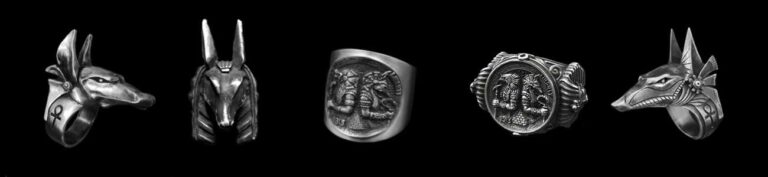
Across the pieces in this guide, the most consistent visual cues are a long canid muzzle, upright pointed ears, an Egyptian-style collar or torso treatment, and a strongly vertical or forward-facing head. These are design observations, not a test of historical accuracy. Different artists can simplify, exaggerate, or geometrically divide the same broad motif.
The museum boundary matters because ancient Egyptian art did not use one single pose. The Metropolitan Museum of Art identifies a Ptolemaic-period wooden statuette as a canid-headed god, probably Anubis, shown with a human body and elaborate clothing. A separate Met record identifies a limestone statue of Anubis as a recumbent canid. Those records support the limited conclusion that both anthropomorphic and animal forms occur in surviving material. They do not establish that every modern jackal-headed ring copies a specific ancient object.
For source-level detail, consult The Met Open Access record for object 590939 and The Met Open Access record for object 544075. The records identify their own dates, media, dimensions, provenance, and curatorial descriptions. This guide does not extend those object facts to MENSSKULL products.
Frontal jackal mask
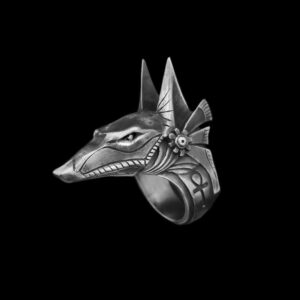
A frontal mask usually creates the strongest symmetry. The ears form a tall outer frame, the muzzle holds the centerline, and eye recesses can create high contrast. On a ring, this format can occupy more vertical and horizontal space than a conventional signet. The front-facing Anubis head ring is the clearest example in the current group: its listing gives a 54 × 27 mm reference and 55 g weight, although the two measurement axes are not separately defined.
Geometric bust and collar
A geometric bust breaks the face and neck into angular planes. Instead of relying only on deep organic carving, it uses edges, panels, and collar lines to make the motif readable. The geometric Anubis ring combines a long muzzle, tall ears, a wing-like collar, and a side ankh detail. Its listing gives 23 × 42 mm, 25 g, and fixed US ring-size options from 7 through 15, including half sizes.
Raised figure on a plate
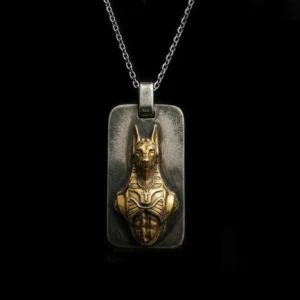
A raised figure creates a different relationship between subject and background. The figure projects from a flat or textured field instead of becoming the entire outline of the piece. The raised Anubis dog tag pendant uses this approach on a rectangular plate. The product record lists 92.5% sterling silver, a 70 × 52 mm size reference, and a weight above 30 g. It does not identify a chain as part of the offer and does not publish the internal bail opening.
Coin and medallion composition
A coin pendant contains the imagery within a circle, making the border and reverse as important as the central relief. The Anubis and Horus coin pendant is listed at 33 × 33 mm and 40 g in 925 silver. Its product page describes a two-sided medallion with Egyptian-themed imagery on one face and a buffalo-style coin composition on the other. No exact archaeological coin, denomination, or replica source is claimed.
Anubis ring or pendant: which format fits your intent?
The format decision should come before small differences in carving. A ring and pendant can share the same motif while behaving very differently in an outfit and during wear.
| Decision | Anubis ring | Anubis pendant |
|---|---|---|
| Visual position | On the hand; visible to the wearer and others during gestures | At the chest; controlled by necklace length and neckline |
| Scale questions | Face height, projection, band fit, neighboring-finger clearance | Pendant dimensions, listed weight, bail opening, chain-end hardware |
| Styling role | Often a concentrated hand-level statement | Can sit alone over a shirt or layer with restrained neckwear |
| Adjustment | Requires the correct available ring size | Necklace drop can change when paired with a compatible chain |
| Common uncertainty | How large the face feels on the hand | Whether a particular chain or clasp passes through the bail |
Choose a ring when the hand is the focal point
An Anubis ring works when you want the motif to be part of your hand silhouette. The face can be visible while you hold a phone, a bag, or a steering wheel, so the design remains present without depending on a neckline. The tradeoff is that ring scale is three-dimensional. Tall ears and a projecting muzzle can extend beyond the band, and a loose substantial face may rotate.
Use actual ring-size options rather than assuming that a broad statement ring fits like a narrow band. The gold-accent ring currently lists US 5 through 15, while the frontal and geometric all-silver rings list US 7 through 15. Each includes half sizes in the live product selector. For a complete measuring process, use the men’s ring sizing guide before choosing a variation.
Choose a pendant when necklace drop matters more
An Anubis pendant is easier to position relative to a shirt opening, jacket, or other necklace. A compact bust can sit as a dense sculptural detail, while a dog tag or coin reads as a larger graphic field. The main technical question moves from ring fit to chain compatibility.
Do not equate a visible chain in a photograph with confirmed inclusion. For the three pendants compared here, the live product records do not publish a chain specification as part of the offer. The pendant and chain compatibility guide explains how to compare the bail opening with the widest end component, not just the nominal chain width. The men’s necklace length guide owns the separate question of where the pendant will sit.
Verified comparison of six current Anubis pieces
The table below reproduces current WooCommerce product attributes checked on August 23, 2026. Dimensions are shown exactly as listed. Where an axis is not named, this guide does not relabel it as width, height, or depth. Weight and dimensions help comparison, but they are not universal comfort ratings.
| Piece | Format and design | Listed material | Listed size | Listed weight | Current size choices |
|---|---|---|---|---|---|
| Raised Anubis dog tag | Rectangular pendant with raised full figure | 92.5% sterling silver | 70 × 52 mm | 30 g+ | Not applicable |
| Anubis and Horus coin | Two-sided round pendant | 925 silver | 33 × 33 mm | 40 g | Not applicable |
| Anubis bust pendant | Compact jackal-headed bust and layered collar | 925 silver | 35 × 17 mm | 31 g | Not applicable |
| Gold-accent Anubis ring | Gold-colored head over dark layered relief | 925 sterling silver + 18K gold, as listed | 35 mm | 40 g | US 5-15, half sizes included |
| Front-facing Anubis head ring | Large symmetrical all-silver jackal mask | 925 silver | 54 × 27 mm | 55 g | US 7-15, half sizes included |
| Geometric Anubis ring | Angular jackal bust, collar, and side ankh | 925 silver | 23 × 42 mm | 25 g | US 7-15, half sizes included |
These facts create useful distinctions. The frontal ring has the highest listed weight in this group. The geometric ring is the lightest of the three rings. The dog tag has the largest listed two-axis pendant reference. The coin is square in its published dimension pair because both values are 33 mm, even though the object is round. Those statements compare catalog data only; they do not rank craftsmanship, comfort, popularity, or value.
How to compare ring scale without relying on close-up photos
Product photography is designed to reveal detail, which can make pieces of different sizes appear similar on screen. A better comparison uses four checks.
1. Read the listed face reference conservatively
A two-number listing tells you that two dimensions were recorded, but it does not always define the axes. Keep the values as a reference pair unless the product page explicitly labels width and height. Compare them with a ruler on your hand, not with another enlarged browser image.
2. Study projection in side views
Frontal area is only part of perceived scale. Tall ears, a long muzzle, and a raised collar create depth and can change how the ring interacts with cuffs or neighboring fingers. Side and worn images answer different questions from the front image. If a view is unavailable, treat depth as unconfirmed rather than estimating it.
3. Use listed weight as a comparison, not a promise
Within this six-piece set, listed weights range from 25 g to 55 g. Weight can help distinguish a compact geometric ring from a much larger frontal mask, but it cannot predict comfort by itself. Band shape, finger size, fit, center of mass, and wear duration also matter. A high number is not automatically better, and a lower number does not guarantee that projection will go unnoticed.
4. Confirm the selected variation
Ring-size ranges shown here describe the live options at the time of verification. Select the exact size on the product page and confirm it again in the cart. Do not infer adjustability from an open-looking gallery angle; these three rings use fixed size variations.
How to compare pendant scale and chain requirements
Pendant selection requires two separate measurements: the pendant itself and the path through which the chain must pass. The listed pendant width does not tell you the internal bail opening, and the nominal chain width does not tell you the size of its clasp or end cap.
Start with visual mass
The 70 × 52 mm dog tag is designed around a large rectangular field. The 33 × 33 mm coin concentrates 40 g into a round medallion. The 35 × 17 mm bust is narrower, but its 31 g listing indicates a dense sculptural form rather than a thin flat charm. These are three distinct visual roles even before chain length enters the decision.
Then verify the narrowest passage
The chain must pass through the bail or connect through compatible hardware. Check the widest component that needs to pass through, which may be the clasp, end cap, or jump ring. None of the three current pendant records publishes a maximum chain width or internal bail dimension. That missing number should remain unconfirmed until measured.
Keep chain inclusion separate from styling photos
The verified product fields identify pendants but do not publish a chain material, length, or package specification. For that reason, this guide treats each offer as the pendant unless the product page or cart explicitly states otherwise. If you need a ready-to-wear set, confirm the selected chain option before payment rather than assuming inclusion from an image.
Material descriptions: what 925 wording does and does not tell you
The US Federal Trade Commission explains that a product described as sterling silver should be at least 925 parts per thousand pure silver. Its consumer guidance also stresses accurate representation of precious-metal content. See the FTC’s consumer guide to buying platinum, gold, and silver jewelry and the agency’s Jewelry Guides resource.
That standard helps interpret “925 silver” and “92.5% sterling silver” in a listing. It does not establish an item’s weight, dimensions, construction method, gold-layer thickness, historical accuracy, or chain inclusion. Those facts need their own evidence.
The gold-accent Anubis ring uses the catalog wording “925 sterling silver + 18K gold.” The page does not publish a gold-layer thickness, application method, or independent assay. It is therefore accurate to describe the visible gold accent and repeat the listed material, but not to invent a plating specification or durability promise.
Historical context without turning jewelry into a false artifact
Anubis is a subject with real historical and cultural depth, so buyer guidance should distinguish museum evidence from modern design language. The Met records cited above identify specific ancient objects, periods, materials, and forms. They support the existence of canid-headed and recumbent Anubis representations in ancient Egyptian art. They do not certify a current retail design, and they do not assign one mandatory personal meaning to everyone who wears it.
A modern ring may emphasize symmetry, armor-like planes, dark relief, or oversized ears because those choices work visually in metal. A coin pendant may combine several Egyptian-themed figures or pair them with a modern coin-art reverse. Those are contemporary composition choices unless a product is documented as a replica of a named object.
Use the existing Anubis ring guide as a supporting product-oriented route, and the Egyptian rings guide or Egyptian pendants guide when comparing Anubis with Horus, scarab, pharaoh, and other Egyptian-themed motifs. This hub owns the narrower ring-versus-pendant and design-format decision.
Facts this guide intentionally leaves unconfirmed
Responsible comparison includes naming what the available records do not establish. The current product fields do not identify an archaeological source object for any of the six pieces. They do not publish a museum license, ritual use, independent precious-metal assay, handcraft method, production origin, edition size, sales rank, review-based preference, or universal personal meaning. The pendant records do not publish internal bail dimensions or a chain package specification. The gold-accent ring does not publish the thickness or application method of its gold-colored area.
Those gaps are not defects that should be filled with guesses. They are boundaries for the buying decision. A shopper can still compare visible form, listed material, dimensions, weight, live ring sizes, and the distinction between a ring and pendant. If a missing measurement is essential, ask for that exact measurement before ordering. If cultural attribution is essential, return to a named museum record rather than relying on retail copy. This separation keeps product evidence, historical evidence, and personal interpretation in their proper roles.
A practical Anubis jewelry buying checklist
- Format: Decide whether you want the motif on the hand or at the chest.
- Silhouette: Choose frontal mask, geometric bust, raised figure, compact bust pendant, or coin composition.
- Scale: Compare published dimensions with a physical ruler. Keep unnamed axes unnamed.
- Weight: Use it to compare pieces, not to predict universal comfort or quality.
- Ring size: Measure the intended finger and select a live fixed-size variation.
- Projection: Review front, side, rear, and worn images for ears, muzzle, collar, and relief depth.
- Chain compatibility: Check bail opening and the widest end hardware; do not rely only on chain width.
- Offer contents: Confirm whether a chain or accessory is explicitly included.
- Material wording: Repeat only the published material and do not add an unverified layer thickness or process.
- Historical boundary: Treat the piece as modern jewelry unless a named replica source and provenance are documented.
For commercial browsing after these checks, explore the Egyptian rings collection. Category pages help compare available products, while this guide remains the decision framework.
Anubis jewelry FAQ
What is the simplest way to choose between an Anubis ring and pendant?
Choose a ring when you want the design to shape the hand and you can verify face scale, projection, and ring size. Choose a pendant when you want control over necklace drop and can verify bail, chain hardware, and offer contents. The motif can be similar, but the fit questions are different.
Does every Anubis design copy the same ancient Egyptian object?
No. Ancient material includes more than one Anubis form, and the modern pieces compared here use different compositions: frontal mask, geometric bust, raised figure, compact bust, and coin medallion. No exact museum-replica source is published for these six products.
Which current MENSSKULL Anubis ring has the highest listed weight?
Among the three rings verified for this guide, the front-facing Anubis head ring has the highest listed weight at 55 g. The gold-accent ring lists 40 g, and the geometric ring lists 25 g. These are product attributes, not comfort or quality rankings.
Are chains included with the three Anubis pendants?
The verified product records do not publish a chain material, length, or package specification for these pendant offers. Treat chain inclusion as unconfirmed unless the selected product option or cart explicitly states it.
What does “925 silver” mean in these listings?
FTC consumer guidance says sterling silver should be at least 925 parts per thousand pure silver. The wording does not by itself establish weight, dimensions, construction, chain inclusion, gold-layer thickness, or historical authenticity.
Does wearing Anubis jewelry guarantee protection or a spiritual result?
No such result is established or promised here. Museum sources provide historical context for specific objects, while MENSSKULL products are modern jewelry. Personal interpretation belongs to the wearer and should not be presented as a universal historical fact.
How can I judge an Anubis ring’s real scale online?
Compare the listed size with a ruler, inspect side and worn views, note the weight, and check the exact ring-size variation. Close-up photography reveals detail but does not provide a consistent scale between products.




MENSSKULL Journal Notes
Leave a field note
Share fit notes, styling ideas, care questions, or your experience with MENSSKULL silver jewelry.
Comments are checked before publication so buyers can read useful fit, symbolism, care, and style notes without spam noise.
The simple plus/minus challenge below helps block automated spam while keeping the experience lightweight.
Continue exploring
More MENSSKULL stories
Handcrafted silver
Shop the pieces behind the stories