
Start with the visible profile, not a universal meaning. A skull bracelet can place its motif at the clasp, repeat it across the wrist, enlarge every link into a skull form, or concentrate the design in one central plaque. Those arrangements create different visual rhythms even before you compare finish, width, or the rest of an outfit.
This guide helps you choose among those observable profiles. It does not assign a fixed symbolism to skulls, prescribe wrist allowance, evaluate clasp security, or make material, care, comfort, durability, sports, or injury claims. Use the linked specialist owners for those questions and the current product pages for item-specific selectable options.
Quick answer: choose the motif layout first
The fastest way to narrow a skull bracelet is to ask where you want the skull detail to appear. A clasp-accent bracelet keeps most of the visible line in conventional links and places the motif at one endpoint. A repeated-link bracelet distributes smaller skull details along the chain. A full-skull bracelet makes the motif the complete structure. A plaque bracelet creates one broad focal area with quieter links around it.
No one layout is automatically more authentic, fashionable, or expressive. The useful question is which profile gives the amount and location of visual attention you want.
View the complete bracelet before studying individual skull details. A design that looks dominant in a macro photograph may read as a narrow repeating line at normal distance, while a broad plaque may remain the first visible element.
Four skull-bracelet profiles at a glance
| Profile | Where the motif appears | Visual rhythm | What to compare |
|---|---|---|---|
| Clasp accent | One endpoint or closure area | Mostly linear with one concentrated detail | Link scale, clasp visibility, surface contrast |
| Repeated skull links | Intervals along the bracelet | Alternating motif and connecting line | Repetition rate, spacing, outline clarity |
| Full skull links | Across nearly every visible unit | Dense and continuous | Motif scale, finish option, negative space |
| Focal plaque | One broad center element | Single visual anchor with quieter sides | Plaque length, edge shape, link contrast |
Use the table as a visual sorting tool. It does not replace the measurements and selectable options on an individual product page.
Clasp-accent bracelets: detail at the endpoint
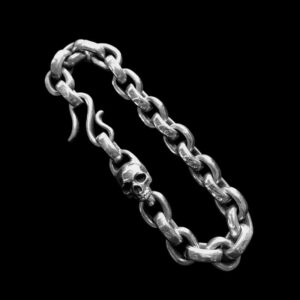
A clasp-accent profile reads first as a chain bracelet. The skull appears when the closure area rotates into view or when the bracelet is deliberately positioned. This makes the motif intermittent rather than continuous. The result can work for someone who wants a conventional link line with one recognizable skull detail.
The current Skull Clasp Chain Bracelet listing identifies a 10 mm size label and a skull detail at the clasp. Those facts establish its catalog profile only. They do not prove how often the clasp will face outward on a particular wrist or how it will move during wear.
Repeated skull links: a patterned rhythm
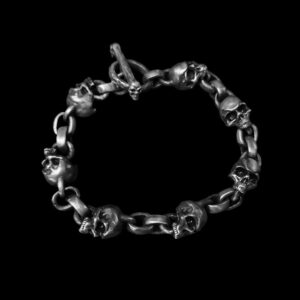
Repeated skull links create a sequence rather than a single focal point. From a distance, the bracelet may read as a dark-light pattern. At closer range, the repeated faces become clearer. Compare how much connecting metal remains between motifs, whether the skull outlines face the same direction, and how strongly the recessed areas separate each unit.
The Heavy Skull Link Bracelet currently carries a listed 7.6 mm diameter label and repeats the skull form along the bracelet. That listing can illustrate visual density and repetition. Its listed weight and selectable sizes belong to the product page and are not used here to predict feel or suitability.
Full skull links: the motif becomes the structure
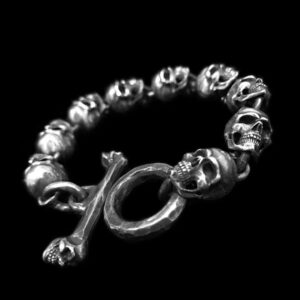
A full-link profile removes much of the neutral chain between motifs. Each visible unit contributes to the skull sequence, so the design remains prominent from multiple angles. This can create a denser outline than a bracelet with a single skull clasp or occasional motif links.
The Full Skull Link Bracelet lists 25 by 20 mm for its skull-link size and presents Full Black and Half Black style options. Those current labels support comparison of motif scale and surface contrast only. They do not establish material performance, finish longevity, or a universal style preference.
Focal plaque bracelets: one broad visual anchor
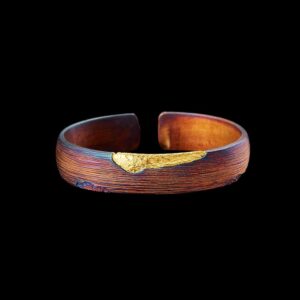
A plaque bracelet concentrates attention in one central shape. The plaque can provide a larger field for texture or a skull image while the curb links act as supporting lines. The eye usually reaches the plaque first, then follows the bracelet around the wrist.
The Hammered Skull Plaque Curb Bracelet currently lists a 10 mm width and shows a central hammered plaque with a skull motif. Treat that as a current catalog example of the focal-plaque role, not evidence that one plaque size is right for every wearer.
Compare repetition before comparing detail
Repetition determines how much of the bracelet participates in the motif. One skull detail creates an accent. Several skulls create a pattern. A complete row creates a dominant motif field. A plaque creates a single visual stop. Decide which rhythm you prefer before comparing teeth, eye sockets, surface marks, or other close-up details.
This sequence keeps the choice practical: layout first, motif scale second, surface contrast third. It also prevents a macro product photograph from making every design look equally prominent.
Use listed width as a scale reference, not a fit verdict
Width influences how much visual area the bracelet occupies. A 7.6 mm label and a 10 mm label describe different listed scales, while a 25 by 20 mm skull-link label describes the dimensions of a repeated motif unit. Those numbers help you compare catalog-defined proportions, but they do not determine wrist allowance or physical feel.
For measurement and selectable-size decisions, use the dedicated men’s bracelet size guide and confirm the current variation labels on the product page. This article deliberately leaves sizing procedures and fit judgments with that owner.
Surface contrast changes how clearly motifs read
Dark recesses can separate a skull’s eyes, teeth, and outline from raised silver-colored areas. A lighter presentation can make the overall bracelet read as one continuous metal line. Compare the product gallery from front, side, and angled views to see whether the motif remains legible outside the closest image.
Surface contrast is an appearance choice here. Questions about alloy labels, hallmarks, or technical silver facts belong to the 925 sterling silver Research guide. This page does not use visual darkness as proof of composition, age, quality, or condition.
Choose wrist prominence by outfit context
A bracelet becomes more or less prominent depending on sleeve length, watch presence, garment texture, and the number of other accessories. A full-skull sequence can remain visually dense beside a plain short sleeve. A clasp-accent chain can appear quieter when most of the skull detail turns away from view. A plaque can create one clear focal point beside a simple cuff.
If you are deciding between a chain and a cuff within workwear, the workwear jewelry guide owns that broader outfit question. This page stays focused on differences among skull-bracelet profiles.
Decide how a watch changes the composition
A watch introduces another case shape, strap or bracelet line, and focal point. You can separate the two items across the wrists, keep one item visually dominant, or use a quieter skull profile beside the watch. The goal is not exact matching; it is a clear hierarchy.
For the specific same-wrist question, see whether to wear a silver bracelet and watch on the same wrist. That guide handles watch-and-bracelet spacing and visual balance without turning this article into a fit or safety page.
Balance a bracelet with rings on the same hand
A skull bracelet and a ring can share one side when their visual roles are distinct. A dense full-link bracelet may need a quieter ring. A focal plaque can pair with a ring whose face is smaller or differently shaped. A clasp-accent chain leaves more room for a ring to act as the main motif.
The dedicated guide to wearing a ring and bracelet on the same hand owns that coordination decision. It is linked here so this page can remain a bracelet-profile comparison.
Current catalog examples by observable role
| Current example | Catalog-defined profile | Listed scale used here | Decision it helps illustrate |
|---|---|---|---|
| Skull Clasp Chain Bracelet | Clasp accent with conventional links | 10 mm label | Whether one endpoint should carry the motif |
| Heavy Skull Link Bracelet | Repeated skull-link pattern | 7.6 mm diameter label | Whether the motif should repeat at a narrower scale |
| Full Skull Link Bracelet | Continuous full-skull sequence | 25 by 20 mm skull-link label | Whether the motif should dominate the complete outline |
| Hammered Skull Plaque Curb Bracelet | Central focal plaque with curb links | 10 mm width label | Whether one broad center element should lead |
These examples were current and purchasable during the prebuild check. Availability, price, selectable options, and listing details can change, so verify the live product page before making a purchase decision.
What outside trend coverage can and cannot show
Broad launch coverage such as ELLE’s September 2026 jewelry overview can show that editors are discussing varied jewelry forms in a dated market context. It does not establish demand for skull bracelets, validate a MENSSKULL product, or prove that a specific motif layout is currently popular.
External coverage, community questions, current product listings, and gallery observations do not prove that one bracelet profile, motif, or product is universally fashionable. They serve different evidence roles and should not be combined into a popularity claim.
Common comparison mistakes
Do not compare only close-up skull faces while ignoring the complete bracelet outline. Do not treat a listed width as a prediction of physical fit. Do not infer sterling-silver composition from color alone. Do not assume a heavier listed weight means better construction. Do not assign a universal meaning to skull imagery. Do not interpret a darkened recess as proof of age, care needs, or durability.
Instead, compare the motif layout, repetition, visible scale, surface contrast, and relationship to your other accessories. Those are the observable decisions this owner can answer without crossing into specialist claims.
A five-step visual decision
- Choose the motif location: clasp, repeated links, full sequence, or central plaque.
- Compare the listed width or motif dimensions as scale references.
- Check whether the gallery shows clear outlines from more than one angle.
- Decide whether the bracelet or another accessory should be the main focal point.
- Confirm current selectable options and route fit, material, and technical questions to their dedicated owners.
Final choice: select the profile you want to see
Choose a clasp-accent bracelet when you want one intermittent skull detail, repeated links when you want a patterned rhythm, full skull links when you want the motif across the complete outline, or a focal plaque when you want one broad central anchor. Then use listed scale, gallery angles, and surface contrast to separate similar options.
For broader browsing, compare the skull bracelet collection with the wider men’s silver bracelet collection. Keep the final decision tied to the visible profile and the current product listing rather than unsupported promises about meaning, quality, or performance.

MENSSKULL Journal Notes
Leave a field note
Share fit notes, styling ideas, care questions, or your experience with MENSSKULL silver jewelry.
Comments are checked before publication so buyers can read useful fit, symbolism, care, and style notes without spam noise.
The simple plus/minus challenge below helps block automated spam while keeping the experience lightweight.
Continue exploring
More MENSSKULL stories
Handcrafted silver
Shop the pieces behind the stories